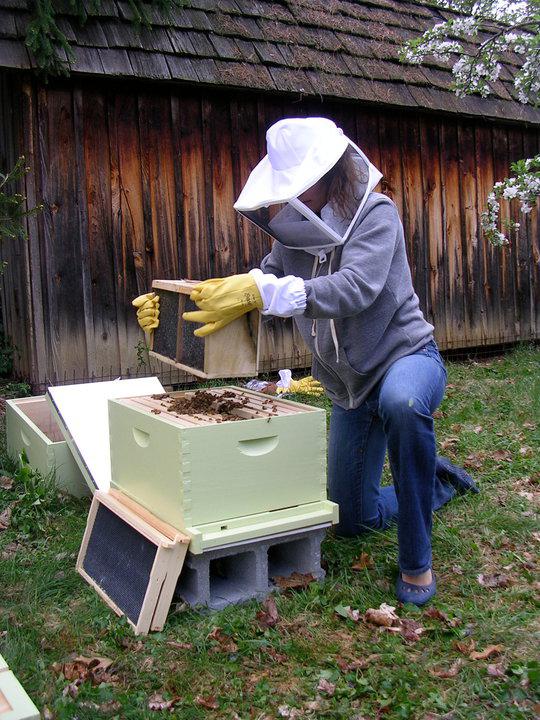
I was hesitant when, in 2009, my then-boyfriend, Tyler, asked if I were interested in keeping bees. I did not much care for honey and was alarmed by the prospect of stings. But when we ended up renting an apartment with a small orchard in the yard, we decided to give it a shot. We proudly documented the first few weeks and months, with photos that I now recognize as miscaptioned; the oversized gloves I wore on the day I dumped our new bees into a hive make me laugh now! Everything we learned showed how much more we had to figure out. One year, some equipment stored in our apartment became infested with wax moths, a common pest, which we only noticed when the moths began fluttering around our main living area in large numbers. Still, we got through the ups and downs and managed to keep one and then two colonies alive for a few years.
Bees gather nectar for honey from the flowers from several square miles around their hives and so, over time, I came to feel that I had a stake in the local environment and flora. I began to pay more attention to the succession of blooms, grateful for the odd out-of-reach maple flowers in early spring, the last asters in fall, and the abundance in between. Plants that I had once dismissed as common I now saw as charismatic totems of the seasons in the northeastern United States: dandelions in spring, sumac in summer, a dozen varieties of goldenrod in fall. I checked the weather more often, worrying when a dry summer stayed dry.
“We begin with noticing,” declared a recent essay: noticing the ecological entanglements that we are caught up in but so often overlook (Tsing et al., 2017, p. M7). Noticing was how I began. It was only later that I heard honey bees described as a “gateway bug,” but it was that idea—that keeping bees can lead to new connections to the landscapes around them—that prompted my research over much of the last ten years. And the core of that research was getting my own hands dirty, literally: smudged with sticky, fragrant resin from the hives, or swollen after a sting, or dusted with gold, gingerly helping Tyler, now my husband, saw off his wedding ring after a bad sting of his own.
Is more intimacy with and knowledge of wild bits of nature the necessary basis for a deeper effort to protect it? Writer Paul Kingsnorth’s “Confessions of a recovering environmentalist” suggests that this kind of “real, felt attachment” to the Earth motivates people more powerfully than abstract notions of “sustainability” (2017, p. 68). This is the rationale for the many calls for “reconciliation with nature” through activities like gardening and ecotourism (von Essen and Hansen, 2019, p. 1), activities intended to challenge to what environmental researcher Holly Jean Buck has called the “disenchanted” Anthropocene (2015). News of environmental change can feel far-off and hypermediated, with consumers’ choices at the end of long, complex supply chains creating butterfly effects over which we have no control. By contrast, Buck writes, “enchantment can enable the passion, care, revulsion, action, networks, sense of place, relationships, and so on that help bring about … socioecological transformations, offering greater momentum for mobilization” (2015, p. 372).
A key site of enchantment is relationships to nonhuman animals. Donna Haraway’s When Species Meet is perhaps the definitive scholarly reference on such encounters. Haraway writes about how we humans might recognize and build on alliances with nonhumans, learning to “pay attention” (similar to the observation above, about noticing) to members of companion species and the many other creatures with whom we are interdependent (2008, p. 19). Such relationships and encounters with nonhuman animals are facilitated by “embodied,” immediate practices (Buck, 2015, p. 372). Beekeeping is shockingly intimate and humbling, a dizzying rush that engages all five senses simultaneously. To inspect a hive is to handle alien creatures who appear to scarcely notice the beekeeper, but who might also attack en masse at any moment.
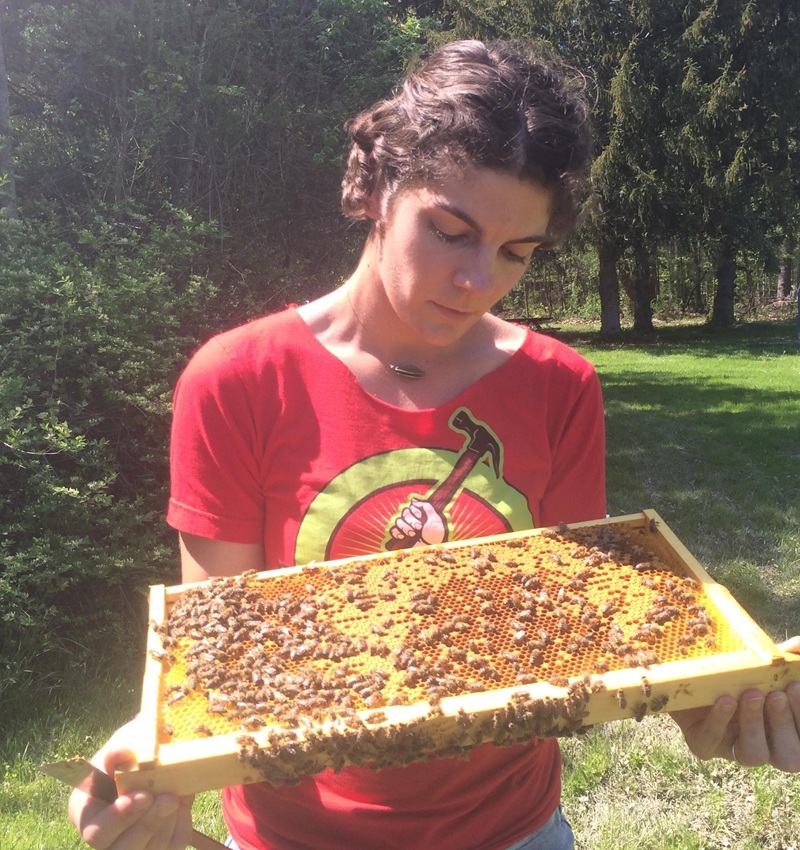
Environmental humanist Stephanie LeMenager has written about “skilling up” as a way to think about these relationships with other species and a necessary task of the Anthropocene (2021). UK researcher Emily Adams has described how beekeepers must develop the ability to “read” the bees and their work in the hive (2018), gaining “skilled vision” and the “education of attention.” Skill is perhaps by definition responsive to context and conditions, negotiating the limits of other materials or creatures; for LeMenager, skills are in part about “working with recalcitrant non-humans” (2021, p. 210) (emphasis added).
While any agricultural endeavor requires at least some attention to basic natural phenomenon, beekeeping arguably requires more such attention than most, as bees fly and forage freely. Less can be controlled in beekeeping, and more must be responded to. A beekeeper must accept what cannot be changed or undone, and also change what she can, if necessary (by medicating the bees, moving them, replacing the queen, etc.). The skilled beekeeper recognizes the difference. This formulation is derived from the “Serenity Prayer” (God, grant me the serenity to accept the things I cannot change, courage to change the things I can, and wisdom to know the difference), which has been proposed as a mantra for the Anthropocene (Robbins and Moore, 2013).
Indeed, skill is not just doing; it is knowing, and knowing more often means doing less. A skilled beekeeper knows enough to take anticipatory actions, for instance, staying a few steps ahead of a colony that might swarm. As well, the skilled beekeeper also knows when not to meddle; from the outside of the hive, she can see whether foragers are bringing back pollen, which indicates that larvae are being fed and might allow her to avoid or delay manipulating the colony in some way.
Some of these are advanced skills, but there is also a minimum floor: if beekeeper is not sufficiently skilled to manage the many threats to her colony—parasites and disease, starvation in lean months, exposure to agricultural pesticides—her colony is nearly guaranteed to die. Indeed, if the first thing a beekeeper learns is how to pay attention to the ways that her bees are situated in a broader environment—and therefore how her practices must be, in order to be skillful—the second thing is the long list of pests and diseases that threaten those bees. In brief, honey bees are being parasitized by Varroa mites, which entered the United States in the 1980s and are the number one direct stressor of honey bees here (Genersch, 2010).
As I have described elsewhere, beekeepers are divided about how to manage their mites, mostly along the lines of what is considered “natural” (Andrews, 2019). Conventional and commercial beekeepers largely insist on the need to skillfully apply pesticides (miticides) directly to honey bee colonies to kill the mites, but a significant fraction of beekeepers, particularly newer ones, see miticides as anathema to caring for bees. But the idea that using miticides is not natural and therefore bad for the bees is part of a false dichotomy. More bees survive when their inevitable mites are managed.
A rich vein of scholarship dispenses with the idea of untouched nature and the related, misplaced sense of nostalgia for “pure” nature, which complicate imperatives around conservation and sustainability today (Marris, 2011; Shotwell, 2016). Recognizing the honey bee’s dual nature—both wild and livestock, at the interface of agriculture and the environment—is in keeping with these anti-dualist conceptions of nature. In other words, the idea of the Anthropocene has been a useful tool for me to make management decisions about my own bees and understand tensions in beekeeping more broadly.
My tolerance, even celebration of miticides, makes my research somewhat contrarian within social scientific literature. But it is based on my own long-term learning curve as I lost colonies over the years to poor mite management. My mite levels were sky-high the one year that my colonies were a part of a mite monitoring study, an embarrassing lapse in front of colleagues. Regular work is needed to avoid such losses: monthly mite checks during the summer and fall, hive manipulations to reduce mite numbers, the careful application of miticides, ideally re-checking mite numbers after such interventions, and more. All of this effort kept mites centered in my research, as I knew it was centered for so many other beekeepers. I wrestled with choices: do I use a mite management technique that has a low tolerance for error and requires more trips to the hive, but which is easier on the bees than one that is simpler and faster to administer? Critiques of development warn against the substitution of labor and skill by “overrides” (Weis, 2013), but I came to appreciate why overrides or other substitutions have gained so much ground.
Still, have I let the pendulum swing too far? Have I let my worries about mites eclipse broader questions about the political economy of honey bee health or environmental health more broadly? Beekeepers are working against the global spread of not just Varroa mites but other pests and diseases, so-called novel ecologies, and unprecedented land use change in a “permanently polluted world” (Liboiron, Tironi, & Calvillo, 2018, p. 332). The challenges to beekeeping are broadly socialized, and putting the responsibility for bees’ health entirely on the shoulders of beekeepers is nonsensical: widespread change is needed.
Ten years after our initial foray into beekeeping, Tyler and I found ourselves managing half a dozen colonies—until two toddlers took our attention elsewhere. I look forward to when my hands will again be sticky and fragrant with honey and resin (instead of drippy popsicles and God knows what else), grounding my research in ecological enchantment.

Ellie Andrews is a geographer and political ecologist currently working in the Critical Environments Lab at the Colorado School of Mines. She teaches and conducts research on energy, climate change, and social change.
References
Adams, E. C. (2018). How to become a beekeeper: Learning and skill in managing honeybees. Cultural Geographies, 25(1), 31–47.
Andrews, E. (2019). To save the bees or not to save the bees: Honey bee health in the Anthropocene. Agriculture and Human Values, 36(4), 891–902.
Buck, H. J. (2015). On the possibilities of a charming Anthropocene. Annals of the Association of American Geographers, 105(2), 369–77.
Genersch, E. (2010). Honey bee pathology: Current threats to honey bees and beekeeping. Applied Microbiology and Biotechnology, 87(1), 87–97.
Haraway, D. (2008). When species meet. University of Minnesota Press.
Haraway, D. (2016.) Staying with the trouble: Making kin in the Chthulucene. Duke University Press.
Kingsnorth, P. (2017). Confessions of a recovering environmentalist and other essays. Graywolf Press.
LeMenager, S. (2021). Skilling up for the Anthropocene. In J. M. Hamilton, S. Reid, P. van Gelder, & A. Neimanis (Eds.), Feminist, queer, anticolonial propositions for hacking the Anthropocene: Archive (pp. 207–22). Open Humanities Press.
Liboiron, M., Tironi, M., & Calvillo, N. (2018). Toxic politics: Acting in a permanently polluted world. Social Studies of Science, 48(3), 331–49.
Marris, E. (2011). Rambunctious garden: Saving nature in a post-wild world. Bloomsbury USA.
Robbins, P., & Moore, S. (2013). Ecological anxiety disorder: Diagnosing the politics of the Anthropocene. Cultural Geographies, 20(1), 3–19.
Shotwell, A. (2016). Against purity: Living ethically in compromised times. University of Minnesota Press.
Tsing, A., Swanson, H., Gan, E., & Bubandt, N. eds. (2017). Arts of living on a damaged planet. University of Minnesota Press.
von Essen, E., and Hansen, H. P. (2019). Reconciliation, welcoming of the wild, and the desire to turn back time. The Journal of Transdisciplinary Environmental Studies, 17(1), 1–4.
Weis, T. (2013). The ecological hoofprint: The global burden of industrial livestock. Zed Books.