Plantations produce many of the commodities that structure everyday life—from the palm oil in processed foods and cosmetics to the soy that feeds industrial livestock, the timber that furnishes our homes, the rubber in our tyres, and the sugar and tea that fill our cupboards. Yet plantations are often imagined as relics of a colonial past: the sugar estates of the Caribbean, the cotton fields of the American South, or the tea gardens of the British Empire. In reality, plantations are expanding across tropical and subtropical regions, driven by growing global demand for food, fuel, fibre, and finance.
The consequences of this expansion extend far beyond agriculture. Plantations are among the leading drivers of deforestation, biodiversity loss, habitat degradation, freshwater depletion, and greenhouse gas emissions. They are also sites of enduring social injustice, where histories of Indigenous dispossession, racialized labour exploitation, and unequal access to land and resources continue to shape contemporary lives. At the same time, plantations are places where humans, plants, animals, microbes, and landscapes are brought into new and often uneasy relationships, generating unexpected forms of coexistence, conflict, and resistance.
Over the past two decades, plantations have emerged as a major object of inquiry across anthropology, critical race studies, geography, history, political ecology, and the environmental humanities. Scholars have shown how plantations were central to the making of the modern world: engines of colonial expansion, racial capitalism, ecological simplification, and industrial agriculture. From Caribbean sugar estates and American cotton fields to contemporary oil palm and soy frontiers, plantations have been understood as infrastructures through which land, labour, and life are organized in the service of profit.
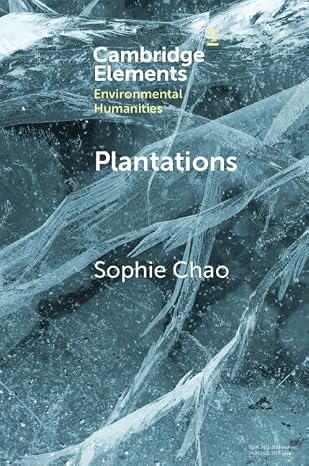
In my latest book, Plantations: Extraction, Extinction, Emergence (Chao 2026), I build on these important insights while asking a different question: what changes when we approach plantations as multispecies worlds? Rather than focusing exclusively on the human institutions and ideologies that create plantations, this Element in the Cambridge Environmental Humanities Series examines how plantations are lived, inhabited, transformed, and contested by diverse forms of life. Humans remain central to this story, but so too do crops, soils, parasites, pollinators, forests, microbes, and animals, whose lives become entangled within plantation landscapes in ways that both sustain and unsettle the plantation project.
To explore these entanglements, the book is organized around three interconnected processes: extraction, extinction, and emergence. Extraction considers how plantations harness the labour, bodies, and metabolisms of humans and other-than-humans alike. Extinction examines the ecological and cultural losses that accompany plantation expansion, from disappearing species to eroded lifeways and relationships. Emergence turns to the unexpected worlds that plantations also generate: new forms of solidarity, resistance, creativity, and multispecies coexistence. The book develops these three themes through a series of historical and ethnographic case studies drawn from plantation worlds across the Caribbean, the Americas, Africa, Europe, South Asia, Southeast Asia, and the Pacific. Moving across these diverse contexts reveals both the remarkable variety of plantation systems and the recurring logics that connect them across space and time.
Extraction explores how commodities come into being through relationships of coercion, care, and labour. It traces the displacement of Indigenous Peoples from lands transformed into monocultures, the exploitation of enslaved and migrant workers, and the racialized labour regimes that continue to shape plantation economies today. It also considers the metabolic work performed by crops themselves, alongside the insects, microbes, birds, fungi, and other organisms whose ecological capacities are harnessed to sustain plantation productivity. In doing so, extraction emerges as a multispecies process through which the bodies, energies, and capacities of many forms of life are enrolled in the production of global commodities.
Extinction turns to the losses generated by plantation expansion. These include the destruction of forests, declining biodiversity, soil degradation, and chemical contamination that have become defining features of industrial monocultures. Yet extinction is understood more broadly than species loss alone. Plantations also erode languages, foodways, cultural practices, and longstanding relationships between people and place. At the same time, the section asks readers to think critically about contemporary sustainability initiatives, conservation schemes, and certification programmes, considering both their achievements and their limitations in addressing the structural violence of plantation systems.
Emergence shifts attention from destruction alone to the unexpected worlds that plantations also produce. Despite their ambitions to simplify landscapes and control life, plantations remain sites of uncertainty, improvisation, and resistance. Across different contexts, workers, Indigenous communities, artists, activists, crops, weeds, parasites, and animals all participate in unsettling plantation order and imagining alternative futures. These stories remind us that even within landscapes shaped by extraction and dispossession, new forms of solidarity, creativity, and multispecies justice continue to take root.
Although grounded in my own long-term ethnographic research on the West Papuan oil palm frontier, Plantations brings together historical, ethnographic, literary, and scientific research from plantation societies around the world, drawing on scholarship in anthropology, geography, history, political ecology, critical race studies, and the environmental humanities. This comparative approach reveals both the diversity of plantation systems and the striking similarities in the social and ecological processes they generate. It also reflects a conviction that understanding plantations requires crossing disciplinary boundaries. Questions of labour, biodiversity, colonialism, race, climate change, and justice cannot be understood in isolation. By placing these conversations into dialogue, the book invites readers to think about plantations as simultaneously historical formations, ecological worlds, political projects, and lived environments.
Ultimately, Plantations argues that studying monocrops is not simply about understanding agriculture or commodity production. It is about understanding how societies organize relationships between land and labour, race and capital, humans and the more-than-human world. At a time of accelerating climate change, biodiversity loss, and widening inequalities, plantations offer a powerful lens through which to examine the enduring legacies of colonialism and the ecological crises of the present. Yet they also remind us that even in landscapes marked by extraction and dispossession, alternative futures remain possible. Imagining counter-plantation futures means cultivating more just, reciprocal, and life-affirming relationships among humans, other species, and the environments we collectively inhabit. Critical to this endeavor is a recognition that unearthing plantation alternatives – or counterplantation futures (Casimir 2020) – stems from scholarly spaces, but also sits on the shoulders of thousands of activists across time and around the world who have fought – and who continue to fight – for access to land and freedom, including the right to inhabit, own, manage, cultivate, work, and dream about such lands according to the principles of sovereignty and self-determination (Chao et al. 2024: 546).
To order a copy of Plantations: Extraction, Extinction, Emergence, visit https://www.cambridge.org/core/elements/plantations/5828D9ACE0B5F9ED6E16D4CCA8C9451F.
Chao, S. (2026). Plantations: Extraction, Extinction, Emergence. Cambridge University Press.
Chao, S., Wolford, W., Ofstehage, A., Guttal, S., Gonçalves, E., & Ayala, F. (2024). ‘The Plantationocene as Analytical Concept: A Forum for Dialogue and Reflection.’ The Journal of Peasant Studies, 51(3), 541–563.
Casimir, J. (2020). The Haitians: A Decolonial History. Translated by L. Dubois. University of North Carolina Press.
Sophie Chao is Senior Lecturer in Anthropology at the University of Sydney. Her research investigates ecology, capitalism, health, food, and justice in the Pacific. She is author of In the Shadow of the Palms: More-Than-Human Becomings in West Papua (2022), Land of Famished Beings: West Papuan Theories of Hunger (2025), and Plantations: Extraction, Extinction, Emergence (2026), and co-editor of The Promise of Multispecies Justice (2022) and Worlds Beyond Bios: The Life of Matter and the Matter of Life (2026). For more information, please visit www.morethanhumanworlds.com.