Blog

Article 9.1 and the Road to Implementation

Photograph captured by Marium Sheikh during the Sharm el-Sheikh Mitigation Ambition and Implementation Work Programme negotiations/

The sixty-second sessions of the Subsidiary Body for Scientific and Technological Advice (SBSTA) and the Subsidiary Body for Implementation (SBI) of the United Nations Framework Convention on Climate Change (UNFCCC), colloquially referred to as SB62, emphasized a shared understanding among parties and observers of the need for intersectional approaches to climate mitigation. Delegates recognized that a one-size-fits-all strategy is ineffective, and instead, responses and goals must be tailored to the diverse geographical, socio-political, environmental, and cultural contexts of affected communities.

One of the key themes at SB62 (held in Bonn, Germany in June 2025) were the necessity for financial strategies that go beyond funding commitments to include accountability frameworks for ensuring that resources are used as intended. Discussions stressed the importance of transparency, responsible finance deployment, and mitigating strategies to avoid duplication of existing and past projects in Least Developed Countries (LDCs) and Small Island Developing States (SIDS) region.

Notably, during the Sharm el-Sheikh Mitigation Ambition and Implementation Work Programme, developed Parties proposed to establish a virtual platform for tracking climate finance flows for better financial deployment and project governance. The idea was quickly rejected by many LDC and SIDS delegates, who argued that it duplicated previous failed initiatives and risked wasting resources without producing concrete results. Party delegates from LDCs and SIDS nations clearly highlighted their needs throughout the meetings, yet the

developed parties failed to take their requests into consideration. Instead, Parties from more developed nations began proposing a country platform that allowed investors to find projects on a secure virtual platform while also allowing projects to seek financiers globally. However, the issue and clear ask by most LDCs and SIDS was prioritizing projects based on immediate climate issues. Most LDCs and SIDS delegates refused to support the country platform as it had no quantifiable outcome promising implementation and on-the-ground results.

This rejection indicated the need for equity-focused impact assessments during project planning. Such assessments could help ensure that funding allocations reflect real community needs and avoid redundant or ineffective interventions. Despite proposals emphasizing finance tracking, measuring, and reporting, these measures often fall short of enabling effective capacity building at the local actionable level. Moreover, the lack of established definition of “Climate Fund” creates transparency and statistical issues in investment reports. The gap in understanding and acknowledging these immediate needs created a great deal of frustration for LDCs and SIDS. Tensions were evident as the discrepancy in understandings set the tone of the negotiations. Parties from developing countries called for efforts to be effectively established instead of fragmented projects that are not resourced, financed, and thought-out.

Simply investing money will not solve the issue. Projects must address the country’s climate needs and acknowledge specific, context-based climate change driven resource gaps such as limited access to water, electricity, education, infrastructure, health care etc. As noted in The Impact of Climate Change on the Development Prospects of the Least Developed Countries and Small Island Developing States (Gul et. al., 2025), “LDCs have a per capita Gross Domestic Product of less than $900 and very low levels of capital, human and technological development.” The recurring debate and inability to increase long term investment value of each project by taking every contributing factor into account has been reflected time and time again with financial promises that come without governance and accountability and cannot meet the urgency of climate adaptation needed to withstand the climate disasters that are now common occurrences for most LDCs and SIDS.

What investees fail to consider is the inability of their approach to address effective climate solutions. While LDCs’ representatives were present in negotiations, their input was not considered, and the upper hand in funding negotiations shifted towards developed country parties. Many highlighted how developed nations continue to fall short of their financial commitments that were made during the Conference of Parties (COP) 29, particularly those tied to Article 9.1 of the Paris Agreement, which states, “Developed country Parties shall provide financial resources to assist developing country Parties with respect to both mitigation and adaptation in continuation of their existing obligations under the Convention.” This emphasizes the developed Parties’ responsibility towards LDCs and SIDs, and the reluctance in investing and providing resources that has been widening the sustainable development gap between nations which will delay climate mitigation and justice. The donor-centric investment efforts means that countries are unlikely to meet their mitigation goals without climate assessments that identify the key factors that potentially hinder climate efforts for the investee country. Capacity constraints are a major hinderance due to the unavailability of skilled labor and inadequate infrastructure which impacts project implementation and the risk of running short on funding. Gul et al. (2025) highlights how making country platforms focused on national and international investment can be made durable by shifting the focusing from the investor to adaptation needs that are locally driven and an effort to build capacity as the platform grows.

A significant breakdown occurred in negotiations toward the end of SB62 where LDCs and SIDS firmly reinstated their needs when they were being pushed into the margins. Delegates repeatedly raised their nameplates, and frustration was evident in their voices and gestures, as developed Parties dominated the negotiations and minimized their immediate needs. The atmosphere in the room grew tense, with some delegates visibly upset at the lack of meaningful progress. Despite these efforts, parties could not agree on an inclusive plan for COP 30 in Belem. The Arab Group emphasized that delaying adaptation finance also delays climate solutions and sustainable development. Pushing vital decisions on implementation and funding forward to 2026 impacts the climate future of LDCs and SIDS who are at increasing climate risk every year. According to the Arab Group, Article 9.1 has repeatedly faced similar breakdowns in previous negotiations, where compliance was either ignored or the needs of investee countries were sidelined. Without governance and strategic planning for financial investments, projects inevitably face multiple obstacles and often result in partial or no outcomes. While everyone was eager to reach consensus and end the session on a positive note, it was unreasonable to move forward without ensuring that LDCs and SIDS were supported, which delayed agreements once again.

The inability to reach consensus and funding needs despite formal agreements remains a recurring and deeply concerning issue. For tangible progress and results, climate finance must be informed by the lived realities of those most affected and not by institutions far removed from the climate impacts on ground. This requires establishing a clear guideline of what “climate finance” truly means, then establishing transparent reporting framework before and after financial deployment that reflects the local needs and obstacles of project members on the ground. As the negotiations move toward COP30, the credibility of the Paris Agreement will depend on whether developed nations translate commitments into actionable and long-term value driven outcomes. SB62 highlighted the increasing value of equity, and how without a thorough anthropological analysis of financial governance, climate finance will remain an empty and unattainable promise at a time when sustainable development is critical to this planet’s future.

Photograph captured by Marium Sheikh during the Sharm el-Sheikh Mitigation Ambition and Implementation Work Programme negotiations/


References

Gul, M., Holland, E., Hassan, A., & Upson, L. (2025). The realities of country platforms for LDCs and SIDS: Ten key lessons. International Institute for Environment and Development (IIED). https://www.iied.org/sites/default/files/pdfs/2025-04/22630g.pdf

International Institute for Environment and Development. (2025). The Realities Of Country Platforms for LDCs and SIDS: Ten Key Lessons. IIED. https://www.iied.org/sites/default/files/pdfs/2025-04/22630g.pdf

United Nations Office of the High Representative for the Least Developed Countries, Landlocked Developing Countries and Small Island Developing States. (2009). The impact of climate change on LDCs and SIDS. United Nations. https://www.un.org/ohrlls/sites/www.un.org.ohrlls/files/the_impact_of_cc_on_ldcs_and_sids_for_web.pdf


Marium Sheikh is a student at the University of Calgary with a background in business, climate equity, anthropology, and research. She studies how global production systems, markets, and resource extraction drive climate change and deepen social inequalities and make them more vulnerable to climate disasters. Her work explores food insecurity, sustainable consumption, climate finance, and just energy transition.
UNFCCC
Blog

UNFCCC SB62 Evaluation: Participation, Power, and Pluralism

As a researcher who has a deep involvement in Indigenous communities in Brazil, I frequently receive questions from community members about how climate decisions are made and who has the authority to speak for whom. These questions, and the urgent need for more transparent and equitable processes, prompted my participation at UNFCCC SB621 in Bonn as an observer. My aim was to understand how decisions are formed within the Subsidiary Bodies process, which directly influences COP-level negotiations. I sought to experience firsthand how pluralism and representation are, or are not, reflected in action within the UNFCCC framework. The UNFCCC’s Subsidiary Bodies comprise the SBI, which addresses implementation issues, and the SBSTA, which provides scientific and technical advice to the climate negotiations (See Chakrabarty and Tater 2025).

Participation, Language Barriers and ‘Just Transition’

While attending, I was struck by the energy and commitment of delegates and observers alike. The sense of urgency was clear. People care deeply about climate change and climate justice. But as the sessions progressed, it became clear that participation is not always matched by influence. Minority and Indigenous representatives were present in the rooms, often making strong, thoughtful interventions. However, I also witnessed how some of these voices were sidelined or subtly undermined, whether through a lack of translation, procedural shortcuts, or rhetorical strategies designed to rush consensus.

In one session, for example, I observed a Brazilian Indigenous participant struggle to follow the discussion due to a missing interpretation. At other times, I heard phrases like “we don’t have time for more detail” or “why are we returning to this point?”, comments that risk silencing legitimate concerns. Yet, those same marginalised voices continued to assert their presence, often with admirable persistence and clarity. Their fight to be heard revealed not only their commitment but also the uneven terrain on which global climate discussions still take place.

Two key areas where this disparity was particularly evident were the discussions around Just Transition and the Loss and Damage Fund. These themes, by definition, should focus on the experiences of those most affected by climate change, yet much of the debate was framed by larger, more powerful parties. In the Just Transition dialogues, I noticed that while many delegations expressed interest in inclusive, equitable pathways, there was little clarity or agreement on how this would be financed or implemented. Indigenous and minority representatives made clear that a transition cannot be called “just” if it does not include them, not only as recipients of aid but as co-architects of solutions. Similarly, in the Loss and Damage debate, there was an acknowledgement of need, but limited progress on ensuring accessible and transparent funding channels for the most vulnerable.

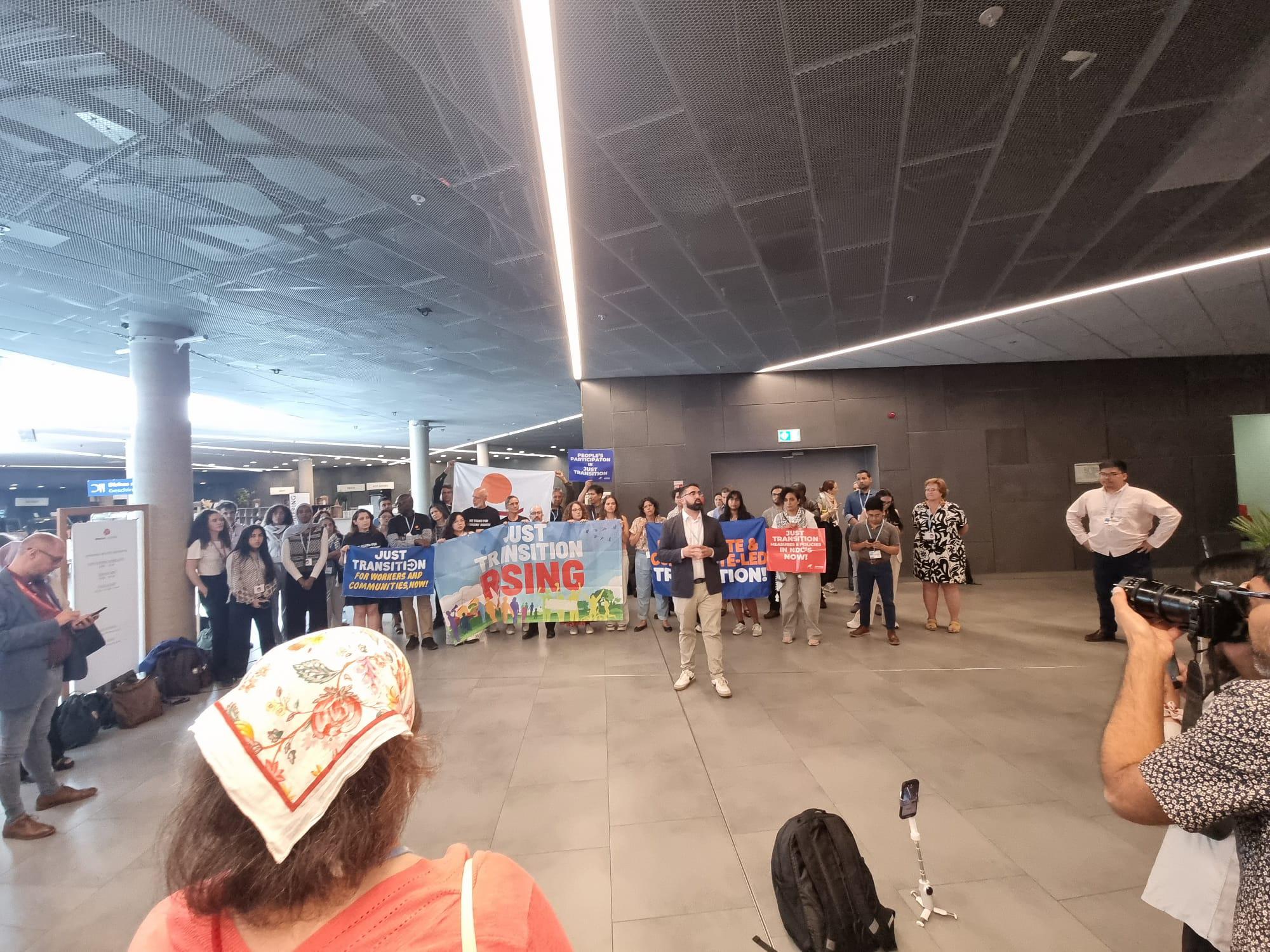
One particularly powerful moment came during a demonstration by some observers attending the conference, who raised urgent questions about the definition of “just transition.” Their message was clear: any transition that overlooks the social impacts of climate change, on workers, on displaced communities, on marginalised populations, is not truly a ‘Just’ Transition. They called attention to the specific realities of countries most affected by climate disruption, such as Caribbean Island nations, where rising seas and intensified storms are already threatening lives and livelihoods. These voices reminded the rest of us that climate justice is not just about carbon, it’s about inequality, memory, and survival. The protest wasn’t disruptive; it was a necessary intervention into a space where procedural language can easily erase lived realities. It underscored the need for climate governance that listens not only to policy, but to people, and especially to those who have historically been excluded from shaping the future.

UNFCCC. Copyright: Vera da Silva Sinha, 2025

Power and Pluralism

Having longstanding experience working with Indigenous communities in Brazil, I approached UNFCCC SB62 with both curiosity and a sense of responsibility. It was evident that Indigenous peoples and other minority communities took part in various sessions, but I continually questioned whether their involvement was meaningful or merely symbolic. This concern intensified as I observed instances of exclusion, not only in who was speaking but also in whose contributions shaped the course of discussions. For example, in several meetings, I noted the absence of interpretation services for non-English-speaking Indigenous delegates, especially from Brazil. Even when they were included in the space, complete participation was hindered without language support. These experiences led me to formulate a set of five key questions, which I used to guide me and ask a representative directly to give me a better understanding of the mechanisms of inclusion in practice.

I need to assess the level of meaningful participation of Indigenous peoples at UNFCCC SB62, beyond formal inclusion in meetings. One Indigenous participant, as an Observer, explained to me that although they have spaces to speak, the relationship is still very imbalanced, especially related to language power. Her account was that: I believe the participation was generally good. We have a very engaged constituency that is present in the discussions and makes collectively constructed interventions. Our positions are also discussed in daily meetings. It is very clear that we still need to make progress in many areas, but it must be taken into account that, for Indigenous peoples who do not speak English as a national language, progress in the discussions occurs more slowly. Even so, the interventions were necessary to distinguish Indigenous peoples from local communities, to ensure their mention in official texts, and to continue the dialogue toward eventually gaining recognition as experts and working actively on the final texts” (Indigenous Brazilian participant as Observer, Author translation).

Other participants, as observers, also noticed and stated similar observations: “Indigenous peoples were present… but were not given the platform or resources to meaningfully contribute” (Canadian Activist and Observer).

I specific asked some Indigenous and non-Indigenous participants about the linguistics provision to include those participants who are not English speakers, and their observations were similar to mine. There is a big problem of inclusion, as the interpretation service is privately provided as I understood: “Most Brazilian participants who did not speak English did not have access to translation services. This is because interpretation services are privately funded by specific groups or projects. In this case, only participants involved in projects that included interpreter support had access to the service. At certain times, the Latin American Youth Scholarship project managed to provide interpretation into Portuguese and Spanish in the UN interpretation booth, but they could only cover sessions where scholars from the project were pre-registered, as well as informal conversation spaces where they were present and offered listening devices. Beyond that, anyone who did not speak English was limited to spaces where translation was available” (Indigenous Brazilian participant as Observer).

Considering the number of essential meetings happening during the event, this exclusion seems to me very significant and can impact the nature of inclusion that is required in the discussions.

Given the scenario encountered, it is crucial to consider how Indigenous voices influence specific decisions or negotiation outcomes, particularly in the context of the LDC discussions or the Loss and Damage Fund. In this regard, one participant said: “The interventions were essential to ensure that Indigenous peoples were mentioned in the guidance texts on the GGA [Global Goal on Adaptation under the UNFCCC]” (Indigenous Brazilian participant, Author translation). However, in the observation of other participants: “Even when they contributed, their perspectives were heard but ultimately not taken into consideration” (Canadian observer).

The current structure of the UNFCCC SB62, as I witness it, appears to marginalise minority groups’ voices in the main discussions among major parties, especially those in which English serves as the main mode of communication. This concern aligns with that of Claire Charlo, an Indigenous Feminisms educator, who stresses during the event on her take up statement the importance of increasing engagement with minority communities globally, with a particular focus on equity for women and girls. Looking toward COP30, it is hoped that minority groups gain more power and that the language barrier does not hinder advancing the agenda. The Indigenous people themselves should be able to articulate their desires, as a participant pointed out: “Only the parties have the right to negotiate the terms… We also do not have Indigenous experts to carry out reviews” (Indigenous Brazilian participant as overflow). As a Canadian observer states, “Many decisions were made on behalf of minority communities… Priority was still given to the comments of developed parties.”

True climate justice requires that Indigenous peoples, the guardians of the world’s biodiversity, be able to fully participate in their own languages and with resources that provide complete translations, as interpretation and translation services are not optional; they are essential for equitable and effective climate governance. Additionally, it is necessary to establish an initial foundation that recognises the legal framework underpinning the language used in these meetings. All members involved need to have specific prior knowledge of the terminology; otherwise, it naturally acts as a barrier to those unfamiliar with such terms and concepts.

Conclusion

Inclusion and pluralism are not achieved if participation occurs without influence, and inclusion without accessibility means that pluralism remains only a desire. To attain effective climate action, these meetings, including the COPs, especially COP30, must ensure that they hear Indigenous voices and that are not only being heard but also genuinely listened to at every stage of negotiations, integrating them into decision-making processes. Unless language barriers, power dynamics, and the promotion of genuine participation through inclusive mechanisms are addressed, climate negotiations will continue to fall short of the justice which everyone envisions.

Acknowledgements:

I would like to express my sincere gratitude to all the activists and colleagues who generously shared their time, insights, and experiences with me. Your thoughtful answers to my questions about the events were invaluable in shaping a thorough, more accurate understanding. This article is as much a reflection of your contributions as it is of my own.


Vera da Silva Sinha is Associate Professor and Principal Investigator, Talent Rep. Program – Conhecimento Brasil, National Council for Scientific and Technological Development (CNPq) in cooperation with the Postgraduate Program in Anthropology (PPGA), Federal University of Paraíba (UFPB). Postdoctoral researcher at the University of Oxford. Email: vera.sinha@gmail.com


References:

Chakrabarty, A., & Tater, A. B. (2025, May 7). Is the UNFCCC climate governance truly pluralist? Examining the Loss and Damage Fund. Engaging Science, Technology, and Society. https://www.envirosociety.org/2025/05/is-the-unfccc-climate-governance-truly-pluralist-examining-the-loss-and-damage-fund/

Claire Charlo, (video Read at 2:06) https://unfccc.int/event/joint-closing-plenary-of-sbsta-62-and-sbi-62-to-take-up-statements.

1 SB 62 refers to the 62nd sessions of the UNFCCC’s two Subsidiary Bodies—the Subsidiary Body for Implementation (SBI) and the Subsidiary Body for Scientific and Technological Advice (SBSTA)—which together held the midyear “June Climate Meetings” in Bonn, Germany, from 16 to 26 June 2025

Blog

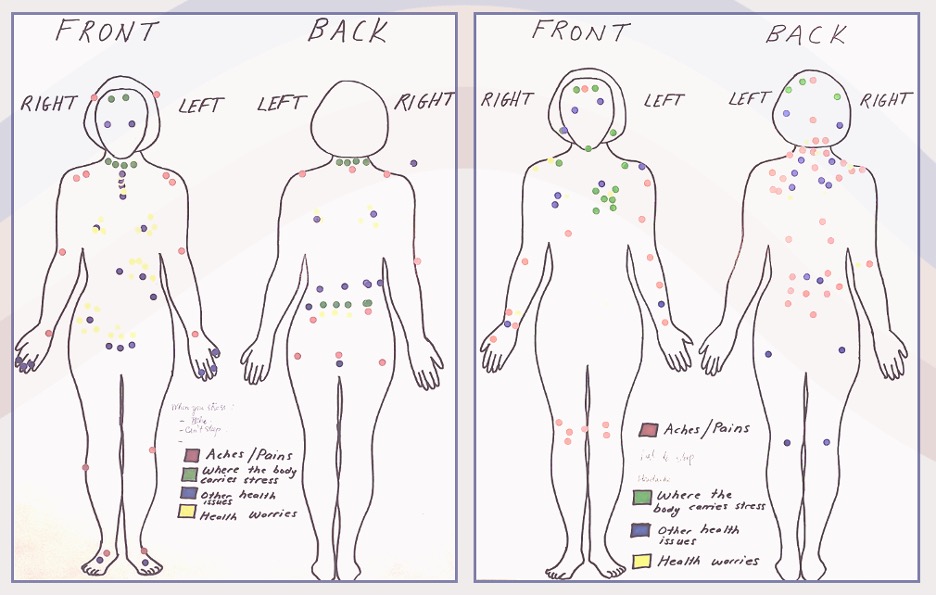
Sensing Cumulative Toxicities

In our everyday lives we encounter and are exposed to a dizzying array of chemicals – through the air we breathe, water we drink, food we eat, products we buy, work we do, and environments we move through. A recent review of the scientific literature estimates that the accelerating mass-production of chemicals has led to the accumulation of 350,000 “novel entities” (human-made chemicals that did not previously exist) in the environment.[1] They suggest this exceeds the “planetary boundary” for chemical pollution, meaning it is and will continue to disrupt the operation of ecological systems and have major impacts on human health.

Conference Review

Confronting Legacies of Toxic Goodness: Speculative Reflections from the 4S 2021 Annual Meeting

Renewable energies, green/blue/bio-economies, waste management systems, as well as sustainable agriculture and aquaculture hold within them the possibility of working towards a “Greater Good”, however, “goodness” is frequently built on toxic colonial and capitalist processes that are rendered invisible through sustainability discourse. How can good practices, relationships, and things be cultivated in an environment where toxicants, toxic politics, and toxic relationalities are constantly reproduced? How do toxic production systems—based on extractivism, colonialism, and plantation capitalism—foment new forms of sustainability that cannot be excised from these deadly foundations?

Conference Review

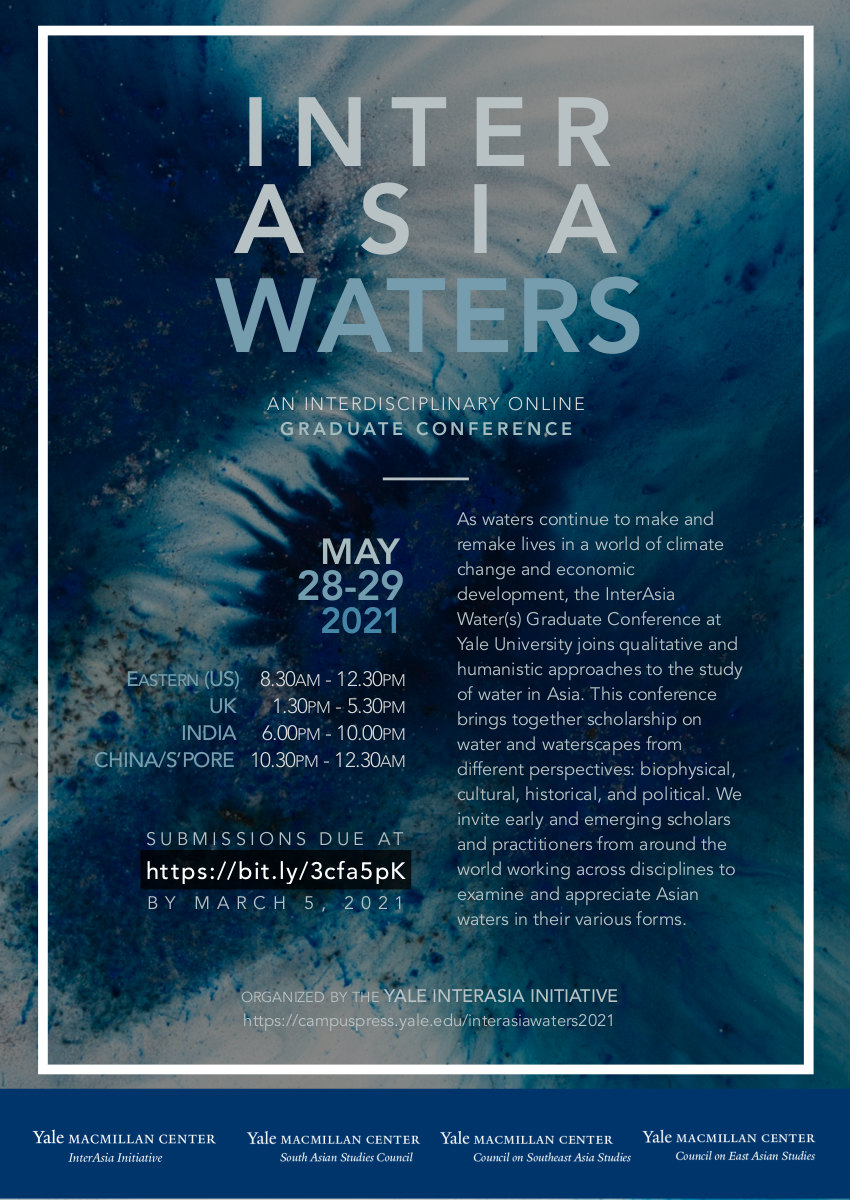
Seeing with Water: Reflections from the InterAsia Water(s) Graduate Conference at Yale University

Rains, rivers, tides, wells—waters, in their multifarious forms, have long shaped social worlds in and across Asia, as indeed in other parts of the globe. As the recent scholarship on its privatization, commodification, and trade, reminds us, water is a vital resource for human life. But it also exceeds such functions. Water mediates, reveals, nurtures, and obstructs social processes, as a site of mobility and immobility, cultural relationships and meanings, as well as political contestation and negotiations.