How should we interpret the outcome of COP21 from Paris? Antonio Gramsci was fond of advising that one maintain “pessimism of the intellect, optimism of the will.” This seems to be the right mindset with which to receive the COP21 agreement. Much of the mainstream media reporting about the agreement betrays an astounding level of ignorance, laziness, and/or apathy regarding the subject. The easy storylines of a “breakthrough,” “game-changing,” or “landmark” agreement ignore the existing context in which the agreement took place. For decades, nation-states have placed cynical geopolitical strategy over the need to address an imminent unprecedented global environmental crisis resulting in maintenance of the status quo and the protection of entrenched economic interests regardless of the cost to the environment and humanity.
“Less Than One But More than Many: Anthropocene as Science Fiction and Scholarship-in-the-Making”
By Heather Anne Swanson, Nils Bubandt, and Anna Tsing
ABSTRACT: How might one responsibly review a field just coming into being—such as that provoked by the term Anthropocene? In this article, we argue for two strategies. First, working from the premise that the Anthropocene field is best understood within its emergence, we review conferences rather than publications. In conference performances, we glimpse the themes and tensions of a field-to-come. Second, we interpret Anthropocene as a science-fiction concept, that is, one that pulls us out of familiar space and time to view our predicaments differently. This allows us to explore emergent figurations, genres, and practices for the transdisciplinary study of real and imagined worlds framed by human disturbance. In the interplay and variation across modes for constructing this field, Anthropocene scholarship finds its shape.
HEATHER ANNE SWANSON, NILS BUBANDT, and ANNA TSING are core members of the Aarhus University Research in the Anthropocene program (AURA). With Elaine Gan, they are editors of the forthcoming Arts of Living on a Damaged Planet: Stories from the Anthropocene and curators of More Than Human: AURA Working Papers. Among their current and forthcoming books are Caught in Comparisons: Japanese Salmon in an Uneven World; The Empty Seashell: Witchcraft and Doubt on an Indonesian Island; and The Mushroom at the End of the World: On the Possibility of Life in Capitalist Ruins.
This article is Open Access under license CC-BY-NC-ND 4. To access all of the articles of Environment and Society Volume 6, which specifically focuses on the Anthropocene, visit the journal’s website here.
The editors of Environment and Societyare accepting papers for its forthcoming issue, Volume 8, in 2017 with a thematic focus on Measurement and Metrics. See the attached announcement for more details on the theme and submission deadlines.
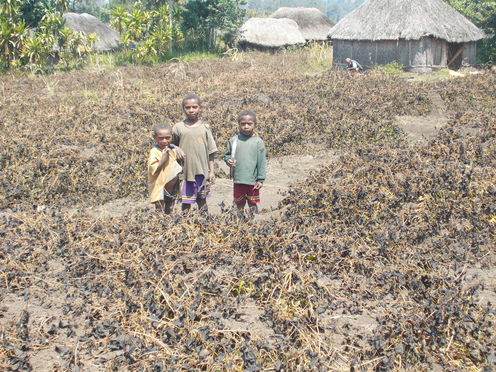
In April 2015, the rains stopped coming to the New Guinea Highlands—a result of the current El Niño impacting the planet. A few months later in August, the inevitable frosts arrived that also accompany El Niños. What few crops were struggling to survive in people’s gardens were utterly decimated by the frosts, for while people garden in the highlands up to 2,800 meters above sea level, the crops they grow are mostly adapted to lowland tropical environments. The staples of the highlands—sweet potatoes (Ipomoea batatas) and taro (Colocasia esculenta)—cannot be stored; therefore, the inability to continually plant and harvest staple crops poses food insecurity for almost 2 million people in Papua New Guinea (PNG).
The latest Environment and Society featured article is now available! This month’s article, “Fisheries Privatization and the Remaking of Fishery Systems,” comes from Volume 3 (2012). Courtney Carothers and Catherine Chambers examine specific examples of how nature-society relationships among people, oceans, and fish are remade as privatization policies take root in fishery systems.
Visit the featured article page to download your copy of the article today before it’s gone! A new article is featured every month.
COURTNEY CAROTHERS is an assistant professor of fisheries at the University of Alaska Fairbanks. She is an environmental anthropologist whose research program focuses on understanding social, cultural, and economic diversity in fishing communities and explores ways to sustain that diversity into the future. In one central area of study, she explores the material, social, and symbolic shifts in fishing livelihoods as fishing rights become privatized. In another, she partners with indigenous communities in the Arctic to study social-ecological change and subsistence ways of life. Her specific areas of expertise include: political ecology; resource enclosure and privatization; indigenous knowledge, science studies, and politics of knowledge; subsistence, mixed, and alternative economies; socio-ecological change; fishery systems; and Alaska Native cultures.
CATHERINE CHAMBERS is a doctoral fellow in the Marine Ecosystem Sustainability in the Arctic and Subarctic program at the University of Alaska Fairbanks. As a recipient of Fulbright and Leifur Eiríksson scholarships, she is currently conducting research through Hólar University College and the Blönduós Academic Center in Blönduós, Iceland. Her dissertation research focuses on subarctic coastal communities and issues of access and participation in marine-based livelihoods.
Liz Lane lights up when I ask her about her seeds. Every year she selects some old reliables and a few new heirloom varieties to try. She is one of my research informants but also my farmer—her vegetables and assorted odd heirloom melons supply my table. Liz and her husband, Mike, farm in southwestern Wisconsin, under the community-supported agriculture (CSA) model. In this model, consumers like me pay a fixed annual sum for a season of organic produce from a local farm. Farmers receive their subscription money in the spring when they most need cash for seed and other supplies. In turn, consumers are invited to work on the farm, to attend harvest parties, and in general to feel connected to the people who produce their food.
Liz and Mike, who are in their early sixties, left their 9-to-5 jobs twenty years ago to purchase their 5-acre farm, where, in addition to growing vegetables, they raise goats and chickens and rent nearby acreage to produce organic feed. They came to organic farming out of deep sense of alienation with the working world, a desire to make a life for their family based in creative work and meaningful community, and a concern for the environment.
This vision of organic farming as an antidote to social and economic alienation is common to many of the farmers who I’ve studied in the course of research in southwestern Wisconsin. They see farming, to use Hannah Arendt’s distinction, as work rather than labor. Arendt sees labor as always inherently alienated, yoked to and in service of a totalitarian political industrial system, and by definition creative of nothing but consumption. In contrast, work is the expression of a creative and vital link to the world, an agentive and purposeful act that results in production. Out of work, it would be possible to create real agency, meaningful politics, and new worlds.
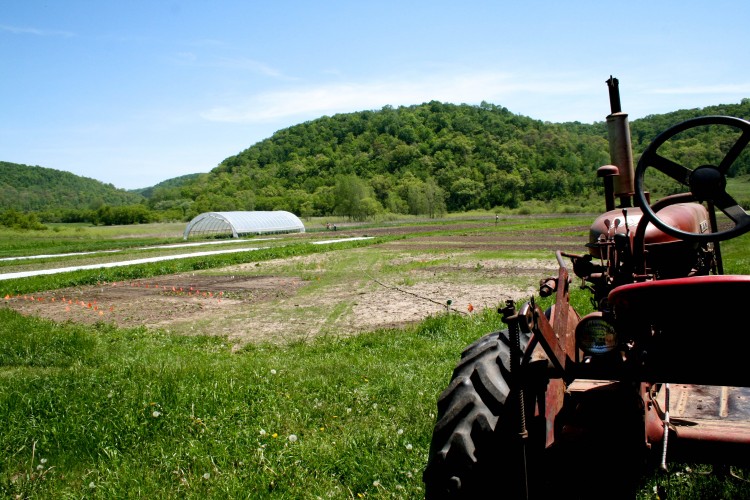
Greenhouse with seedlings ready to transplant on a small CSA farm
Notwithstanding their work, over the years the Lanes have become alienated anew. None of their neighbors are organic farmers. In fact, one family has converted their dairy into a concentrated animal feeding operation where a thousand cows now produce enough manure to pollute the groundwater feeding the Lanes’ well. Another farmer destroyed their entire spring pea crop when he sprayed roundup on a windy day, allowing it to drift over the hedgerow separating the two farms and to land on the maturing peas. While producers like the Lanes take up farming because they desire a certain kind of world, and through their work to make it, the structures of rural society don’t encourage it. Moreover, mortgage payments, health care premiums, taxes, and other costs put heavy earning pressure on the farm.
This requires them to redouble their efforts marketing vegetables through their CSA to attract ever more consumers. Consumers are attracted to CSAs partly out of a desire to find connection and community through the CSA relationship. The cheerful newsletters, recipes, and farm tours necessary to make CSA customers feel connected to their farmers are hard to orchestrate given the dawn-to-daylight routine required to maintain an organic farm. The couple notes that visiting consumers who come to work and play on the farm are pleasant enough, but despite such activities, real community—bonds of mutual obligation and friendship—are seldom forged. While the Lanes certainly value their customers, they have come to see the activities surrounding the CSA—the weeding parties, pumpkin festivals, and soap-making demonstrations—as so much labor. And for the Lanes, when organic farming becomes just a means to put another product on the market, it loses its meaning. Under what circumstances might it be possible to use the work of organic farming to forge new worlds?
Transplanting seedlings by hand
Recently I visited Lafarge, WI, one of the most vital centers for the production of organic vegetables, milk, and meat in the country—and where I do research on organic farming and organic marketing cooperatives. My research is attached to my longstanding theoretical interests concerning environmental social movements and the relationship between alternative political visions and markets in alternative commodities like fair trade and organic foods. It is also attached to my personal dreams and aspirations of abandoning anthropology to become an organic farmer.
For sale was a 34-acre organic permaculture farm with a commercial kitchen that I hoped might somehow be my dream farm. Its sprawling turreted house had been conceived as a restaurant, living space, and homeschool. Its commercial oven and central heating system were wood-fired and supplied by the back 20 acres of forest. An acre of asparagus and a thousand hazelnut bushes—the latter valuable for its convertibility into biofuel—were perennial crops meant to be low maintenance, and that might generate $10,000 in income per year. A store complete with produce coolers was ready for customers. Chicken coops and barns promised housing for future animals. It was a homestead farm—meant to provide the means for self-sufficient rural livelihood.
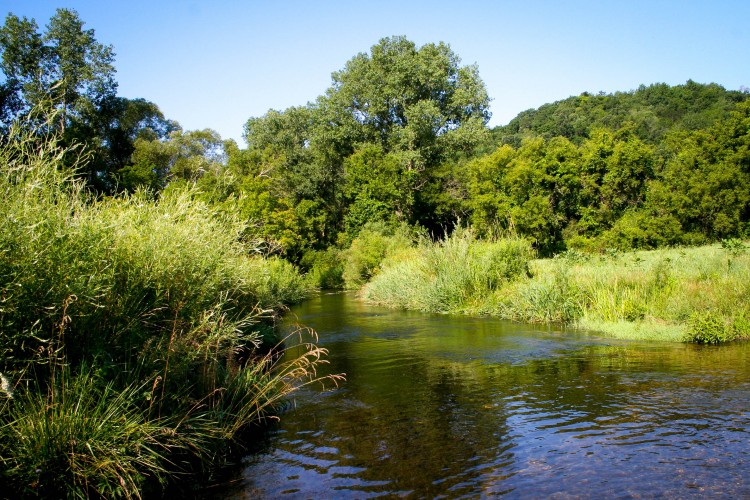
Trout stream running through a Viroqua farm
This beautiful dream was still visible beneath the weeds choking the asparagus, the caved floor of the chicken coop, the house half-finished, all subfloor and studs, the impossible thought of cutting, storing, and stacking enough wood to stoke fires all the Wisconsin winter. Homesteaders in western Wisconsin and elsewhere dream of self-sufficiency for various reasons, including the threat of climate change and the end of fossil fuel availability, the poisoned food system, the numbing drudgery of wage labor, and more positively, the overwhelming desire for creative and fulfilling work that is fully integrated into a joyful life. But small organic farms or homesteads—like the one I looked at—have an extremely high failure rate. The dream—which I would characterize as a desire to live as self-sufficiently as possible with only a marginal connection to the formal labor force or to the market—is very seldom achieved. In practice, small farms depend on wages, pensions, and health benefits from at least one family member.
The Facebook page Small Farm, Sustainability, and Homestead Living illustrates some of these realities. In a recent thread, a member asked, “How many of you out there need to earn some kind of outside income to maintain your farm?” In the hundreds of replies came a list of jobs, pensions, and disability payments that supplemented farm income. Members floated various estimates—ranging from $5,000 to $10,000—of the annual income needed for taxes, mortgage payments, health care premiums, veterinary bills, animal feed, and other expenses that would have to be met even by homesteaders who could produce virtually all of their own food, do all of their own building and repair, and successfully sell surplus production. Small enterprises like these are the bread and butter of farmers markets around the country, where on average a farmer will make about $5,000 per year selling vegetables and other farm products.
The alternative to this marginal existence is to scale up—to transform the homestead farm into an enterprise dependent on wage labor and fully integrated into high-end markets. Jan and Nathan Dermott of Summit Acres Farm decided that in order to be able to quit their day jobs, they would have to scale up. They expanded their operation from 5 acres to 30, and unable themselves to provide all the necessary labor, hired several dozen laborers and a manager to oversee them.
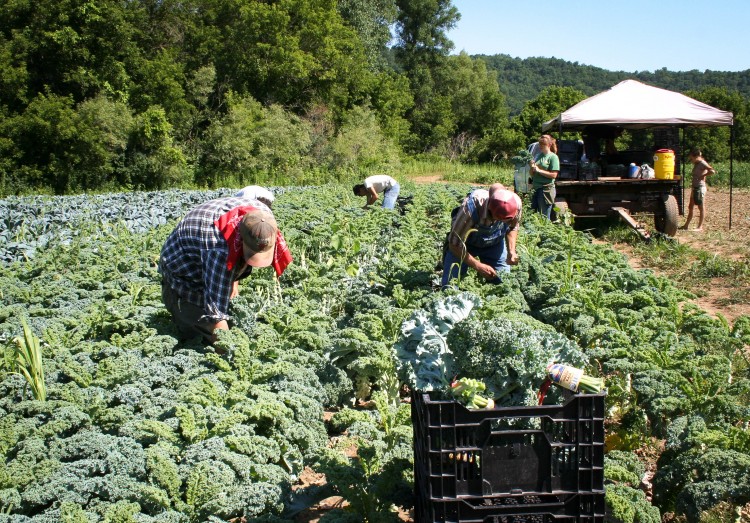
Sweet Water Farm, which nearly went bankrupt after catastrophic flooding in 2008, scaled up in order to rebound. It recruits 30 H2A laborers from Mexico to staff their farm, which is now a multimillion-dollar enterprise. Scaled-up farms sell their produce to Whole Foods and Mariano’s in the Midwest and must meet rigorous production standards that entail considerable upfront capital investment. Blue Ridge Farm specializes in heirloom tomatoes and kale for Whole Foods. They hire teenaged laborers and outsource many tasks, such as seed starting, to Amish neighbors, who, according to Amy, the owner of Blue Ridge Farm, compel their children to stay up all night stoking the fire in the greenhouse when frost threatens.
Tagging kale destined for Whole Foods on a scaled-up farm
But not all vegetables at places like Whole Foods come from “scaled-up” farms. In and around LaFarge, a network of small organic vegetable farms supply restaurants in Madison, Milwaukee, Minneapolis, and Chicago, as well as Whole Foods through the Organic Valley label. In almost every case, vegetables from small farms are collected by aggregators, who resell them at a profit, and overwhelmingly these small farms are Amish. A manager from Organic Valley estimated that 99 percent of the vegetables sold under the Organic Valley label are produced by Amish farmers.
Thus, organic vegetables must be produced either at an industrial scale with wage labor or, in the case of small homesteads both non-Amish and Amish, by undervalued, unpaid, or family labor; otherwise the farm essentially produces at a loss insofar as it is subsidized by wage labor income on the homestead. This is not unlike the agricultural production system in southern Mexico, where I have studied organic fair trade coffee production.
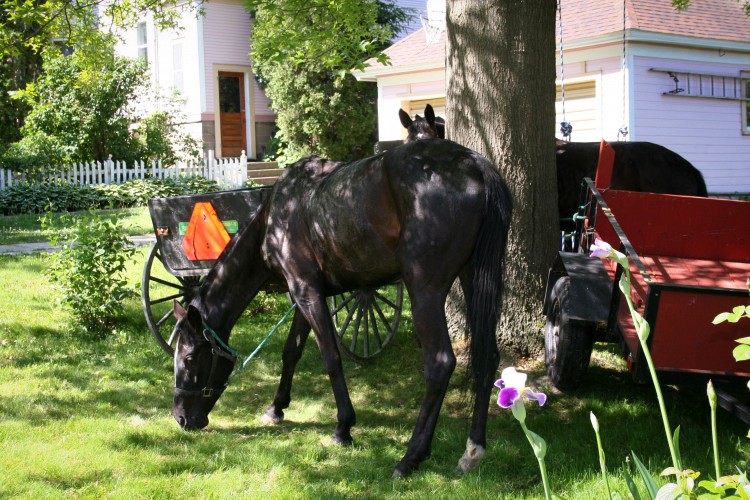
Amish horse and cart parked outside a residence in Viroqua
Organic coffee is produced by family laborers in a peasant commodity production system that has its roots in colonial economic arrangements. In the Accumulation of Capital, Rosa Luxemburg argued that the expansion of capital into noncapitalist frontiers, such as peasant communities, was fundamental to the smooth functioning of capitalist markets. Indigenous peasant communities were granted communal land rights—which they still retain where I work in Chiapas—that allowed them to produce a great deal of their own subsistence.
However, policies of taxation, and the necessity of obtaining some goods through the market, required participation in labor markets. Historically, indigenous people provided seasonal labor on coffee plantations, and when their labor was not needed, they were sent home to live off the land. Thus their ability to self-provision essentially reduced overall wage costs for employers who were not responsible for the entire cost of the reproduction of the labor force, and in turn their inability to entirely self-provision forced them to participate in as laborers and consumers. Contemporary fair trade coffee producers subsidize our drinks by self-provisioning, by using unpaid family labor, and by taking on quality control responsibilities that used to be done by coffee buyers. Thus, accumulation of capital requires taking something for nothing, just as Luxemburg argued. David Harvey has coined the term accumulation by dispossession to capture this.
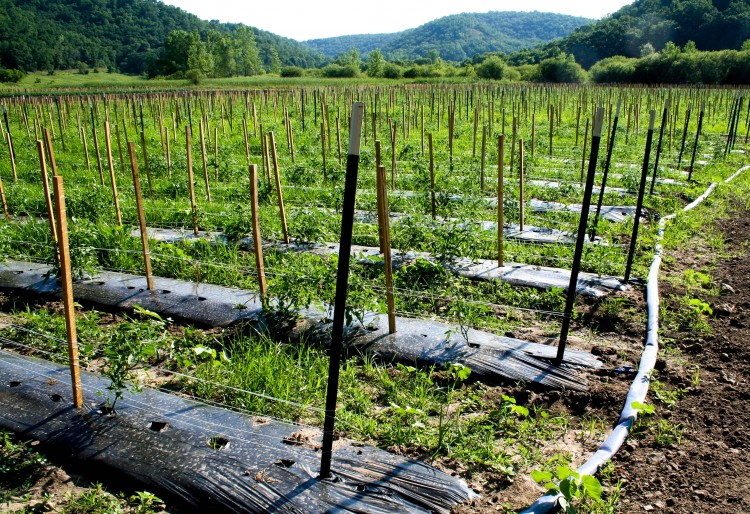
Tomato plants destined for Chicago grocery stores on a scaled-up farm
In Luxemburg’s work, preindustrial or noncapitalist forms of labor are an essential component of the capitalist system, providing a constant source of value, food as it were, to be metabolized. Amish farmers in Wisconsin are an essential source of labor-starting seeds and transplanting seedlings, providing day labor, growing vegetables. In all these activities, they reduce costs for capital-intensive farms and provide reasonably priced vegetables to market. Like Mexican coffee growers, they self-provision, but they also need cash—to buy property, pay taxes, buy various supplies.
The dream of the farm is of work, not simply labor that reproduces a dead consumer society. The small farmers in my research sample demonstrate a huge discomfort with the market, both the labor and the consumption it requires. And yet there is no alternative. In a society like ours, no one can live outside the market. Visions for social change are stymied by it, and fair trade and organic foods do not themselves generate alternative worlds. Like all other commodities, they are products of labor.
Display of locally grown food, Viroqua Food Cooperative
Value accumulation is firmly attached not only to the consumption of those products but also to the ideas attached to them. When CSA farmers host harvest festivals and pumpkin parties, they associate their agricultural products with ideas about authenticity, community, and wholesome foods. As small farmers know, and as Paige West has shown in her work on coffee produced in New Guinea, those images and ideas are themselves products of labor. The dream of the farm, however, rejects the idea of labor and its cycle of endless production for the sake of endless consumption. It recalls Arendt’s notion of work. She sees work as the foundation of real agency, both personal and political. Work is both the outcome of and generative of agency, and collective agency is the precondition for any kind of liberatory politics. But in itself work is not sufficient to create alternative politics. We actually need alternative politics, and that requires work.
Dr. Molly Doane is Associate Professor of Anthropology and Affiliated Associate Professor of Latin American and Latino Studies at the University of Illinois at Chicago. Her research concerns environmental politics, alternative markets, and social movements in Mexico and the United States. Her book Stealing Shining Rivers: Agrarian Conflict, Market Logic, and Conservation in a Mexican Forest won a 2012 “best book” from the Latin American Studies Association. Her research has been supported by the National Science Foundation and the Wenner-Gren Foundation for Anthropological Research. She is co-editor of the book series Critical Green Engagements: Investigating the Green Economy and Its Alternatives, published by the University of Arizona Press.
All photos in this post are credited to the author.
References
Arendt, Hannah. 1998. The Human Condition. 2nd ed. Chicago: University of Chicago Press.
Doane, Molly. 2014. “Politics on the Family Farm.” Anthropology Now 6, no. 3: 46–53.
Doane, Molly. 2010. “Relationship Coffees: Structure and Agency in the Marketplace.” Pp. 229–257 in Fair Trade and Social Justice: Global Ethnographies, ed. Sarah Lyon and Mark Moberg. New York: New York University Press.
My uncle’s name was Cesar. He was a singer and pretty well known around here. He died and was buried, and on the day before this Todos Santos, this Día de los Muertos, when I was in Mexico City, I dreamt that my uncle Cesar came to see me.
“Mi hijo, my son, I am lost,” he said. I looked at Cesar and told him not to worry, that I would take him back to Juchitán with me on the bus. When we got close, I pointed out the window, “Look, uncle, we are here.” We walked from the bus station downtown, and Cesar said to me, “I am so hungry.” So we sat down below the Municipal building where they sell garnachas, tlayudas, and tacos. “I am so hungry,” he said again, and I pushed my plate over to him, “Eat, uncle, eat.”
“Mi hijo, I don’t know where I live, will you take me to my house?” “Uncle, you live all the way in La Ventosa,” I said, but he asked again, “Please, take me.” We walked from downtown to the bus stop by the highway, where the buses leave to go to La Ventosa. Once Cesar had got on the bus, I told him I was going to get off. “Listen Cesar, when you get off the bus in La Ventosa, someone there will recognize you, and they will take you home.”
It was such a strange dream, so I called my mom up to tell her about it.
“Mi hijo, today is Cesar’s first Todos Santos,” she said. “Your cousins, you know they converted to Protestantism, and they never built an altar for your uncle on the first year after his death—they never did Xandú Yaa for him, they never placed candles out for him, there was nothing for him. Your uncle’s soul,” she hesitated, “is probably lost.”
My mom rushed off the phone, “Listen, I need to call your aunt. I have to tell her about your dream, so that they will put something out for him tonight.
— Gubidxa Guerrero, Centro Cultural Herón Ríos (November 1, 2014)
*****
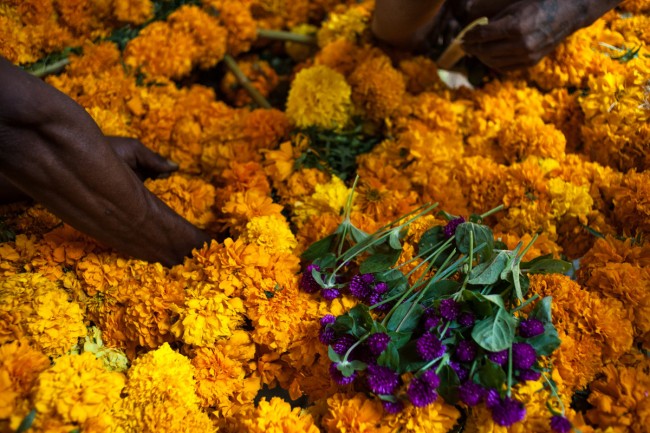
A palpable change occurs in Juchitán in late October. Not only does the town celebrate Todos Santos (the Day of the Dead and referred to as Xandú in Zapotec), but on the Isthmus of Tehuantepec, the seasons also change. Gusiguié in Zapotec means “the season of flowers,” which lasts from April to October. The temperatures are warm, and bi nisa, a soft and feminine wind, arrives gently from the south. As the days pass from May into June, almost all Juchitecos will sweat their way from party to parade throughout this period of important fiestas. Then, come late July, the calendula begins—a forty-day crescendo leading up to the first rain. This subtle change in weather signals to farmers that they must sow their fields in order to prepare for what comes next—rain. When the brief period of rain does arrive, it does so in force. The rain then lets up midway through October, and a refreshing breeze sweeps through town. Starting off slow, the air quickly picks up speed. This wind, called bi yoxho in Zapotec is an “old grandfather”—a forceful wind from the North. This is when the season changes once again. October until April is the season of gusibá, or “the season of the tombs.”
Like most foreigners in Mexico for Día de los Muertos, I possessed a collage of images that defined my expectations for this holiday (Day of the Dead = dancing skeletons). However, what I experienced late in October 2014 was something I had to learn many times over during my fieldwork in Juchitán. My expectations were not only always wrong, but they were also constantly subverted to reveal their total futility.
I had come to Juchitán to conduct fieldwork regarding different experiences and perceptions of the massive industrial-scale wind energy industry that had emerged in recent years. So while I knew a little bit about the wind, I did not expect to find myself fascinated by the Day of the Dead. I didn’t know of any connection, nor did I think I was the best person to study that question. So what I am writing is rather unexpected.
Unlike the state-sanctioned Day of the Dead popularized across the globe, Xandú in Juchitán is a solemn occasion. Juchitecos invite their recently deceased relatives to visit. The souls will quite literally arrive. I had been attending a weekly Zapotec history class at a local community center since I arrived a few months earlier. Our professor was a young historian named Gubidxa, and the class size varied from between eight and ten adults, while neighborhood kids would wander in and out. Our discussion on November 1 was about Xandú, and Gubidxa was urging the other students to reflect on the “why” of their own family’s practices. After various aspects were mentioned, like the fruit that is laid out on the altar, Gubidxa sought to sum up their points to move the conversation forward. “Most of us here have a similar conception of death, especially when it comes to the days of Xandú. The souls of recently deceased relatives will come home. How they do it, who knows? But they are coming. And if they are coming, then we must have everything prepared to receive them, because if we are going to receive them, then we have to receive them properly, as they deserve.”
The elements and procedural details of Xandú, he explained, facilitate the soul’s journey of transformation. Our conversation then turned to some of the unspoken rules. “If someone died on October 20, you aren’t going to make an alter for the Day of the Dead on October 30, are you? No, you are going to wait until the next year. But why?” His enthusiasm started to mount: “Our grandparents have taught us that this is because the deceased won’t be able to make it back that quickly—they are still on their way. Where they going, who knows? But it’s going to take them a while to get there.”
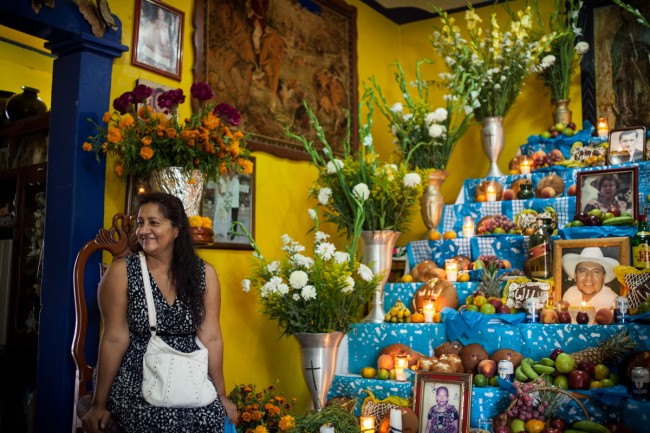
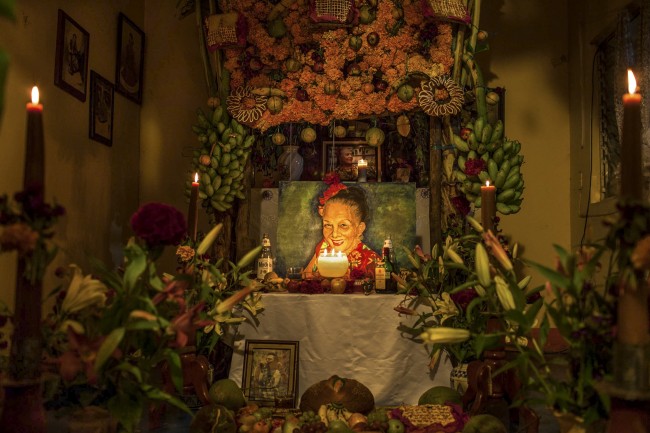
While the essentials—like water, candles incense, flowers, fruit, and bread—are always displayed in abundance, people will also display chocolate, tamales, and “if they liked tlayudas, well, you can put those out too. If they preferred spaghetti, well then you put out spaghetti. The souls will draw out the essence of this food to nourish themselves.” The candles help illuminate the route to guide the soul home, the scents help in this as well. The glass of water—well of course they will be quite thirsty from their long journey.
Altars take one of two forms. The first, biguié or biyé, uses flowers, wood, and banana leaves to construct a square within which four smaller squares are then formed, all of which are then surrounded by a circle. This design is said to derive from the Zapotec calendar—a 260-day year with months that last twenty days. A woven mat is set in front of the biyé whereupon the fruit, candles, food, and water are displayed. From reading and conversations, it seems that the mat is one of the most important aspects of this altar, as it serves to separate space. Following the logic that the souls are quite literally coming, it is on the mat where the living and the dead meet. The other form of altar is like one face of a pyramid, constructed with nine levels, each said to represent one of the levels through which the soul must pass in their journey from this world to the other.
In the days before and after Xandú, I found myself kind of surprised by my interest in the details of ritual practice. I had come to study infrastructure and I thought of myself as a “real modern anthropologist,” blah blah blah. But there was something about it that just grabbed me—perhaps a reason so many anthropologists are drawn to Juchitán.
Everyone agreed—after Xandú, when the altar is dismantled, all of the fruit that has been left out, despite being only a few days old, has no flavor at all. My first instinct when my friends said that was skeptical. As the days passed and I kept talking about it with people, it finally hit me: the aspects of the altar are not merely symbolic—they are also very real. Ashamed by my own disenchantment, I tried to learn what the world felt like if the fruit really had no flavor.
In late October, between the change in season and the solemnity of Xandú, the overall feeling of the city was distinct, and in my memory, it stands out as a time apart from the rest of my fieldwork. Juchitán is normally a very loud place, a city that seems to be quite literally bursting from the seams with noise. But when writing this and recalling this period, the memories are uncharacteristically quiet, except, of course, for the music and the wind. While preparations in the days leading up to October 30 were, per normal, filled with lewd jokes, once evening came, it was conspicuously quiet. We sat on the patio outside the small room where the altar was built. The lights were mostly off, the wind howled, and the hundreds of candles struggled to remain alight.
I can imagine you might be reading this and thinking to yourself, obviously there is a connection between the arrival of the windy season and the arrival of the souls. I am just beginning to go through my field notes, listening back on the materials I gathered last year. I can’t say what it all means just yet. At the time, I was seized by the sensual—the flurry of preparations, the faint scent of copal smoke. But perhaps this convergence of seasonal change and ritual celebration underscores the ways the weather continues to manifest in actions and practices that are ancient but also in a constant state of change. This underscores so much of what I learned over and over again in Juchitán—there is a reason why and how things are done. It is not a logic I could have anticipated but, once experienced, is quite remarkable.
Juchitán itself is a convergence of intensities. The continuity from life to death is reflected in the annual climatic changes.
There seems to be a fortitude to these practices that I had not anticipated. The practices are simultaneously so very ancient and totally adaptive and ever changing. The word “syncretism,” so often used to describe the convergence of indigenous practice with the Catholic Church, just doesn’t seem to do it justice nor account for the ways practices change and adapt. What I observed and was taught by my friends in Juchitán was the complex, conflicted, and ever-shifting ways they grapple with their multiple ways of being in the world. My friends were cosmopolitan and at the same time committed to maintaining a set of practices that seems to help reinforce a very literal relationship to this very place. They are tied to Juchitán by practice—year in and year out. If their loved one’s souls are returning to the home where their umbilical cords were buried, then they must be there as well in order to welcome them as they deserve.
I like to think about these practices and try to embody these beliefs, imagining what it would feel like if my ancestors would come to visit. Not only would they come in October, but then, just as the winds start to slow down and the temperatures begin to rise once again, I would also be able to go to the cemetery, along with everyone else in town, to convivir—coexist—with my ancestors and neighbors for the equally important ritual on Palm Sunday in early April.
Stephanie Friede is a PhD Candidate in the department of Cultural Anthropology at Duke University in Durham, North Carolina. Her dissertation explores the culture and politics of industrial wind energy on the Isthmus of Tehuantepec in Oaxaca, Mexico.
All photos in this post are credited to the author.
Many thanks to my friends in Juchitán and the many scholars who have written about Zapotec relationships with death.
If you are interested in learning more about this place and practices:
De la Cruz, Victor. 2007. El pensamiento de los Binnigula’sa: cosmovision, religion y calendario con especial referencia a los binniza. Mexico City: Casa Juan Pablos.
Norget, Kristin. 1996. “Beauty and the Feast: Aesthetics and the Performance of Meaning in the Day of the Dead, Oaxaca, Mexico.” Journal of Latin American Lore 19: 53–64.
Nutini, Hugo. 1988. Todos Santos in Rural Tlaxcala: A Syncretic, Expressive, and Symbolic Analysis ofthe Cult of the Dead. Princeton, NJ: Princeton University Press.
Royce, Anya Peterson. 2012. Becoming an Ancestor: The Isthmus Zapotec Way of Death. Albany: State University of New York Press.
Cite as: Friede, Stephanie. 2015. “Weather, Ritual, and Día de los Muertos in Juchitán.” EnviroSociety. 30 October. www.envirosociety.org/2015/10/stephanie-friede-weather-ritual-and-dia-de-los-muertos.
The latest Environment and Society featured article is now available! This month’s article, “Nature’s Market? A Review of Organic Certification,” comes from Volume 2 (2011). Shaila Seshia Galvin takes a critical look at literature on organic certification from diverse national and regional contexts while incorporating her own extensive fieldwork with organic smaller holders in north India.
Shaila Seshia Galvin is Assistant Professor in the Department of Anthropology and Sociology at the Graduate Institute of International Affairs and Development Studies (Geneva, Switzerland). Her research interests include political ecology, the anthropology of environment and development, and political anthropology.
Visit the featured article page to download your copy of the article today before it’s gone! A new article is featured every month.
Environment and Society Volume 6 is now available from Berghahn Journals! To access all of the articles of this issue that specifically focuses on the Anthropocene, visit the journal’s website here. The following is an excerpt from Amelia Moore’s introduction to this issue, available as a free PDF download:
The Anthropocene is everywhere in academia. There are Anthropocene journals, Anthropocene courses, Anthropocene conferences, Anthropocene panels, Anthropocene podcasts, and more. It is very safe to say that the Anthropocene is having a moment. But is this just a case of fifteen minutes of fame, name recognition, and bandwagon style publishing? The authors in this issue of ARES think not, and we would like to help lend a critical sensibility to the anthropological consideration of the concept and its dissemination.
We recognize that the Anthropocene is an epoch in formation. As a category and as a concept, the term inspires fear, revelations, skepticism, and all manner of predictions and projects. In other words, the Anthropocene is as generative as it is contested. And as global anthropogenic change becomes an increasingly defining feature of contemporary life, the authors in this issue of ARES look beyond the kneejerk censure of the Anthropocene as an academic fad in order to locate the social and political significance of the idea while it congeals around the world.
What would we say if we heard that the troops from two countries working together were hell-bent on destroying the heritage monuments of a third? In addition to the human lives they took, they destroyed one of the most beautiful groups of buildings in the region, steeped in historical significance. As they did so, they looted fine art treasures to fill the houses of the rich and the museums of the “civilized” world—where they remain. The theft of these treasures caused as much resentment among the descendants of those who lost them as Elgin’s removal of the Parthenon marbles from Athens to Britain. The actions sound like those of the disgruntled Sunni troops of Iraq and Syria in their joint actions, reverting to beheading, blowing up the remains of Palmyra, and selling antiquities to the world market to fund their activities. They also describe the actions of the British and French armies in China in 1860.
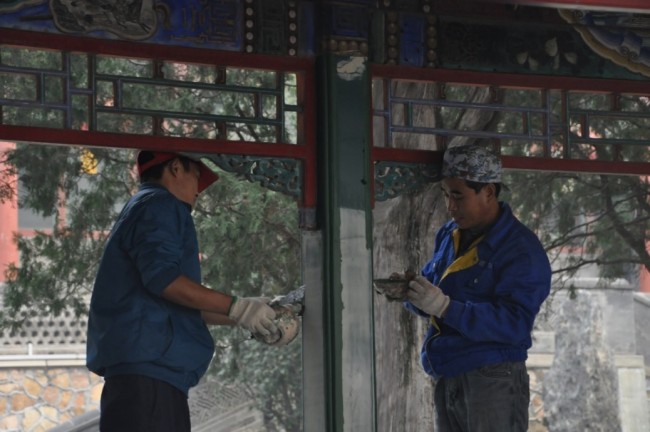
One of the British commanders in China was the son of that same Elgin, engaged in a war in which the troops from France and Britain were supposedly trying to free up trade with China by vicious military action—bizarre though that sounds. It was he who was responsible for the destruction of the Summer Palace in Beijing; his troops looted and pillaged the imperial treasures. A much restored version of the Summer Palace is on the UNESCO World Heritage List. Among the features destroyed by the British but now restored is the 728-meter Long Corridor—so long, tourists are told, that it is in the Guinness World Records. In the harsh climate around Beijing, the fabric of the restored corridor requires almost continuous maintenance.
Workers repainting the timbers of the Long Corridor, Summer Palace, Beijing
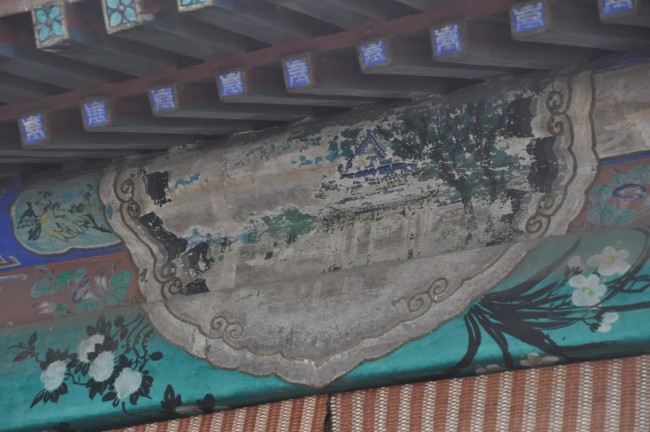
The corridor was decorated with more than 10,000 paintings that have also been reconstructed. They, like the Sydney Harbour Bridge, must be repainted on a regular basis. If the corridor is not original and is constantly renewed, and if the paintings have to be repeatedly restored, we might question the basis for the fame of the material heritage of the Summer Palace as it is shown to tourists. Is it anything more than a tourist attraction, a theme park of the Ming Dynasty, like that replica recently constructed 1,000 kilometers from Beijing where equivalent structures and paintings can be enjoyed by even larger masses of tourists?
Unrestored painting in the Long Corridor, Summer Palace
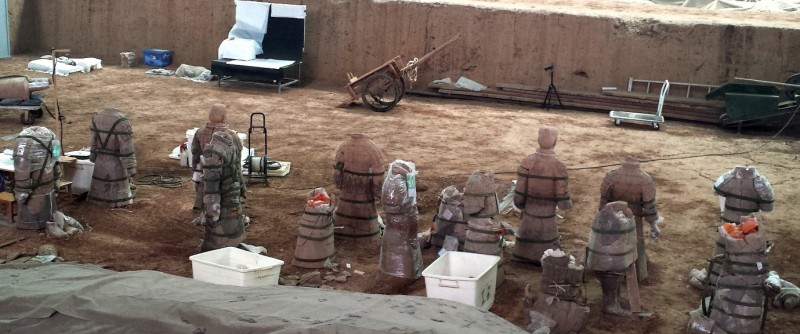
What we are talking about here is the “old man’s spade.” You know the story: the old man used to say that he’d had only one spade all his life, and he had only changed the handle five times and the blade twice. Is the old man saying anything other than that he is just a silly old man? This blog considers the question of the authenticity of the Summer Palace, one of the jewels of Chinese World Heritage. Is it any more authentic than the old man’s claim to have had only one spade? The issues relate equally to the much reconstructed Great Wall or the much renovated Forbidden City. Even the Terracotta Warriors have to be reconstructed before they can be displayed in their astonishing variety.
Terracotta Warriors, Xi’an, in various states of reconstruction
All over the world, important heritage places (such as the Washington Elm, where George Washington supposedly received his command, on Cambridge Common in Massachusetts) have to be renewed (the original tree died) or they lose their impact as heritage places. Does heritage tend toward theme parks, or is “real” heritage somehow different? This is particularly interesting in the light of a proposal for a park north of Sydney, Australia, where Chinese heritage buildings might be copied but would probably not acquire heritage significance. How important is it, when honoring heritage, to call a spade a spade?
In philosophy, the question of the old man’s spade is known as the ship of Theseus paradox and has been discussed since the time of the pre-Socratic philosophers of Greece (Lowenthal 1989). There is even a version that relates to George Washington’s axe, presumably the one he did or did not use to cut down the cherry tree. The philosophical question turns on the interpretation if the ship carried spare timber for repairs during the voyage, and whether it would be the same ship even if it were completely renewed. Can the old man’s spade (or the ship or the axe) be considered the same one after its history of changes? Various thought experiments have been devised to discuss the relevant options. But whether these thoughts are about the use of the same materials, the way the thing was made, the shape of the thing, or the use to which the thing is/was put, the discussion has centered principally on the essence of the material “thing” rather than the relationship between it and other things, places, or people that surround it. Mike Schiffer (1999) has emphasized this three-way communication between people and things in The Material Life of Human Beings and the centrality to human life of human interactions with materiality. Although heritage values might be related to the (generally material) qualities of the heritage thing or place, the fundamental reason for heritage status of the thing or place is the interactions people have with it.
This quality of the importance of the heritage-bearing people—the consumers of heritage—enables the concept of heritage to extend beyond the material to intangible aspects of culture. The heritage is more than the material thing or place; it is also the narratives and interpretations that people bring to it, or anchor to it. But without the material anchor, who can identify the original or reconstructed parts of the intangible? We could engage in a thought experiment of our own, switching from material cultural heritage to intangible cultural heritage. Beside the ship of Theseus paradox about a materially substantive ship, there is a song of Homer paradox, through which we could debate whether the final (written) version of The Odyssey (whatever it says about ships) was the same as had been originally sung by the first person who called himself (or herself) Homer. By this logic, is West Side Story really a modern version of Romeo and Juliet, and is it the same story in the Vanuatu movie Tanna? It turns out that the legitimation of heritage turns on the interaction of these two paradoxes. There is no paradox of the ship of Theseus provided there is an attached history that sings about the history of replacement of parts. The old man’s spade has been with him all his life because he can tell the story that he has never had to replace both parts at the same time. We know the changes between Shakespeare’s and Bernstein’s stories and the one from Vanuatu because there are material versions of them.
The material cultural heritage experience is (generally) tied to a location and anchored by the materiality of what people constructed there. In all cases there is a narrative about special events in the past, which generally are of interest primarily to the people whose lives have been affected by (and are a product of) the relevant histories. These narratives are subject to the song of Homer paradox—no two versions of the history are quite the same, as in the Rashomon effect—just as the material heritage is subject to the changes of materials described in the ship of Theseus paradox. They become objects of tourist interest through the material things, whether beautiful or not, in their context of either dominated or constructed landscapes. All of these elements are needed to create the heritage experience. The Summer Palace was reconstructed in defiance of its destruction by colonial powers, and the destruction and reconstruction have become part of the narrative “song.” And it was built in the same location, beside the same lake, to which are attached singular narratives. No theme park can replicate that combination of material structure, location, and intangible heritage.
Whenever there is a contest about the preservation of the material remains of cultural heritage, we should remember that all cultural heritage preservation is a political act. It privileges the interests of people who are stakeholders in that heritage over those of others. Those stakeholders may be indigenous people, commonly in Australia and the United States, indeed in most countries that have been the victims of colonialism. Their songs will be the most powerful connection between the material and the people. There are others whose “songs” do not provide the complement to the material culture, whose attitudes, therefore, principally focus on the material. Heritage professionals on one side are key stakeholders defending material heritage, while developers or industry shareholders on the other are often not committed to the material or the narrative. Governments will always have an interest, particularly because the protections are legislated by them and most often the preservation must be funded by them. And then there are the interests of the general public. That general public often has multiple sources of narrative. If they are tourists, often that is quite separate from the dominant narrative of their own lives.
How does this discussion inform our understanding of the destruction of heritage buildings in Palmyra? Nothing can justify the murder of Khaled al-Asaad, the archaeologist most closely associated with the place, but nothing can justify many other killings in wars, nor the associated destruction of heritage. The lesson of this comparison is that the destruction of the material of cultural heritage is a common feature of the clash of ideologies. No particular side has been generally virtuous. Material culture can be restored, but the intangible songs and stories, of the people who are custodians of the heritage, may be more difficult to recover unless they survive in a material form. It is the interplay of material cultural heritage and the intangible heritage associated with it that is strongest. The changing ship of Theseus can be interpreted best when there is, in the same frame, a song of Homer, however much that too changes.
Iain Davidson is an archaeologist who also works in Cultural Heritage management. Trained in the United Kingdom, he has worked at the University of New England (Australia) and Harvard. He is working on a volume about the evolution of symbolic behavior in Australia.
His two most recent publications are:
Davidson, Iain. Forthcoming. “Stone Tools: Evidence of Something in between Culture and Cumulative Culture.” In Miriam N. Haidle, Nicholas J. Conard, and Michael Bolus, eds., The Nature of Culture. Springer International Publishing.
Tasire, Alandra K., and Davidson, Iain. 2015. A Fine-Grained Analysis of the Macropod Motif in the Rock Art of the Sydney Region, Australia. Australian Archaeology 80: 48–59.
All photos in this posted are credited to the author.
References
Lowenthal, David. 1989. “Material Preservation and Its Alternatives. Perspecta 25: 67–77, doi: 10.2307/1567139.
Schiffer, Michael Brian. 1999. The Material Life of Human Beings: Artifacts, Behavior, and Communication. London: Routledge.
Cite as: Davidson, Iain. 2015. “Heritage, the Ship of Theseus, and the Song of Homer.” EnviroSociety. 14 October. www.envirosociety.org/2015/10/heritage-the-ship-of-theseus-and-the-song-of-homer.