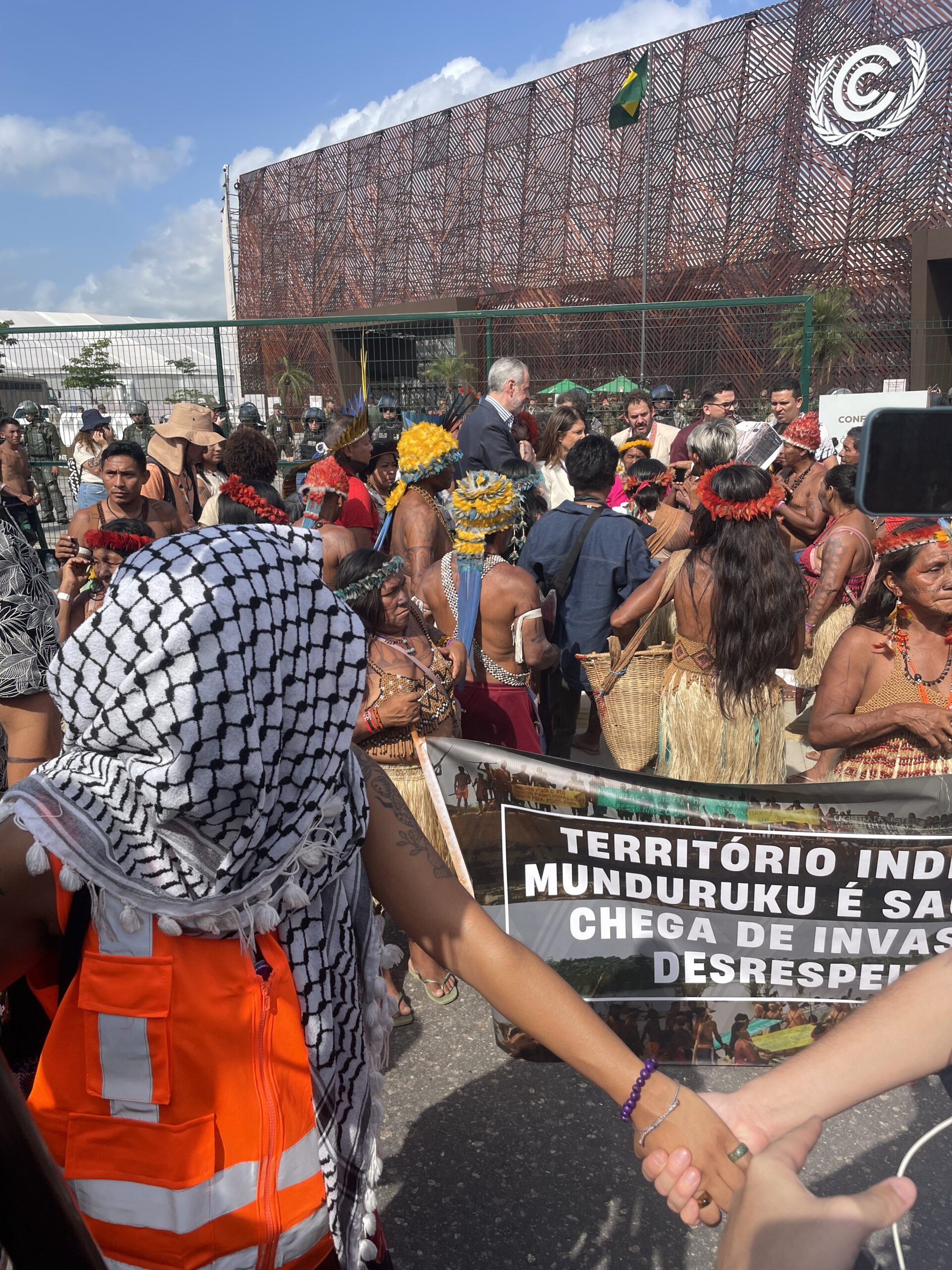
On most days, delegates are rushing through the gate on their way from the city into the premises of COP30’s restricted Blue zone. Not today. On this morning, activists are blocking the gate. On this side of the fence, throngs of delegates congest the street. It is a motley crew of diplomats, lobbyists, activists and observers, many sporting COP30 badges with photo, full name and institution listed. Police cars and ambulances dot the crowd, their lights flashing on. Many people keep moving through the crowd, apparently looking for another entry into the Blue Zone or a refuge from the glaring equatorial sun. Many others stay on, watch what is happening around the gate.
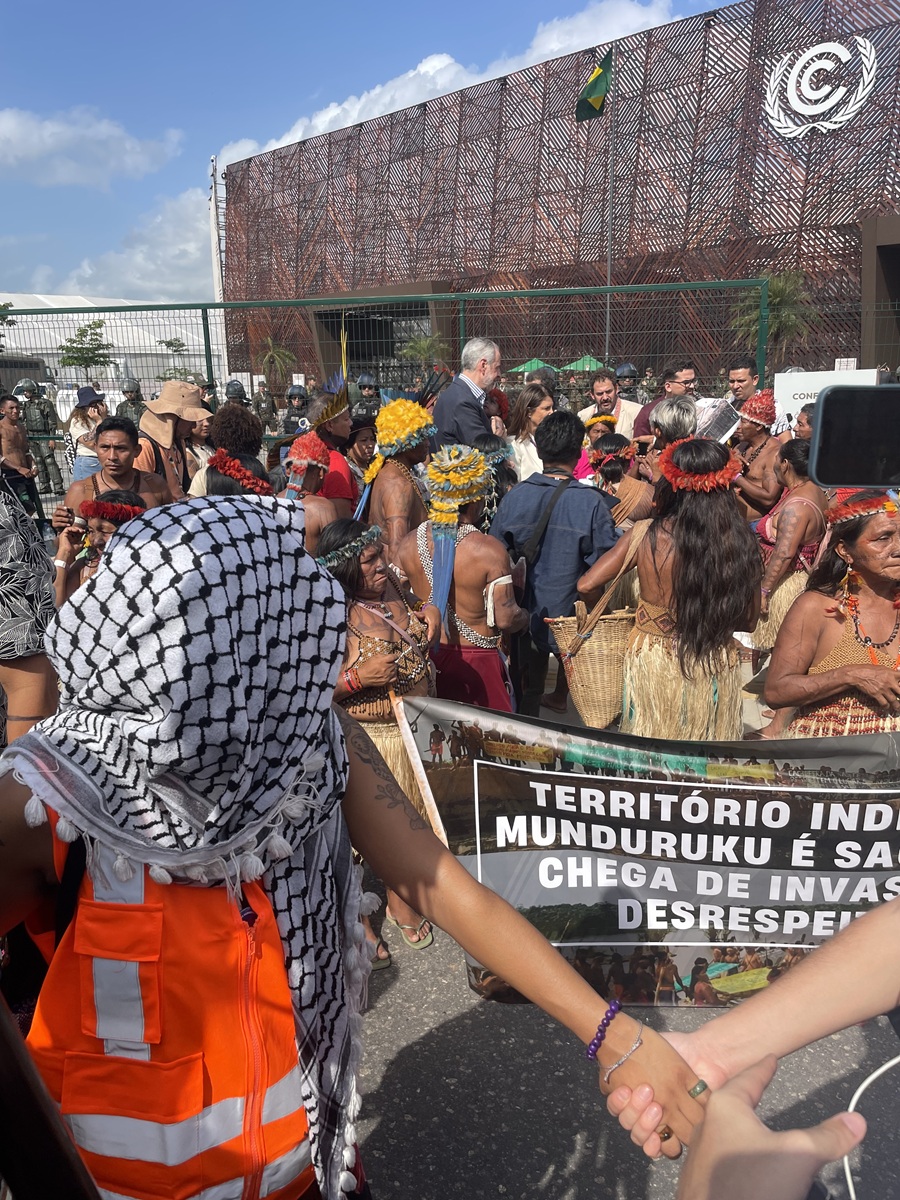
The gate is being blocked by Indigenous activists. Their dresses and feather gowns identify them as Indigenous people from the Amazon not very far from here. Some hold spears; and as the president of the COP30 and his entourage gets close, they start singing, swaying back and forth in a slow two-step dance. Like many others around me, I do not understand what they are singing. But the images and Portuguese slogans on their placards help to get a sense of what this is about. Apparently, they demand abandoning plans to construct hydropower dams on the rivers as well as the termination of illegal gold mining on the lands they call home.
Around the chanting, spear-carrying activists, another activist group has formed a ring. These are mostly white people holding themselves by the hand, in solemn silence and with their backs to the Indigenous protesters, so as to shelter them from the onlookers and police. Many in this outer line wear shirts imprinted with climate activist slogans or strings of buttons, added the occasional reflective west or Palestinian Keffiyeh, and, of course, official COP30 badges. Scuffles erupt with photojournalists trying to break through their line in order to get a better shot at how COP30’s president is now engaging in a conversation with a woman who seems to be a spokesperson of the Indigenous activists, apparently listening to their demands.
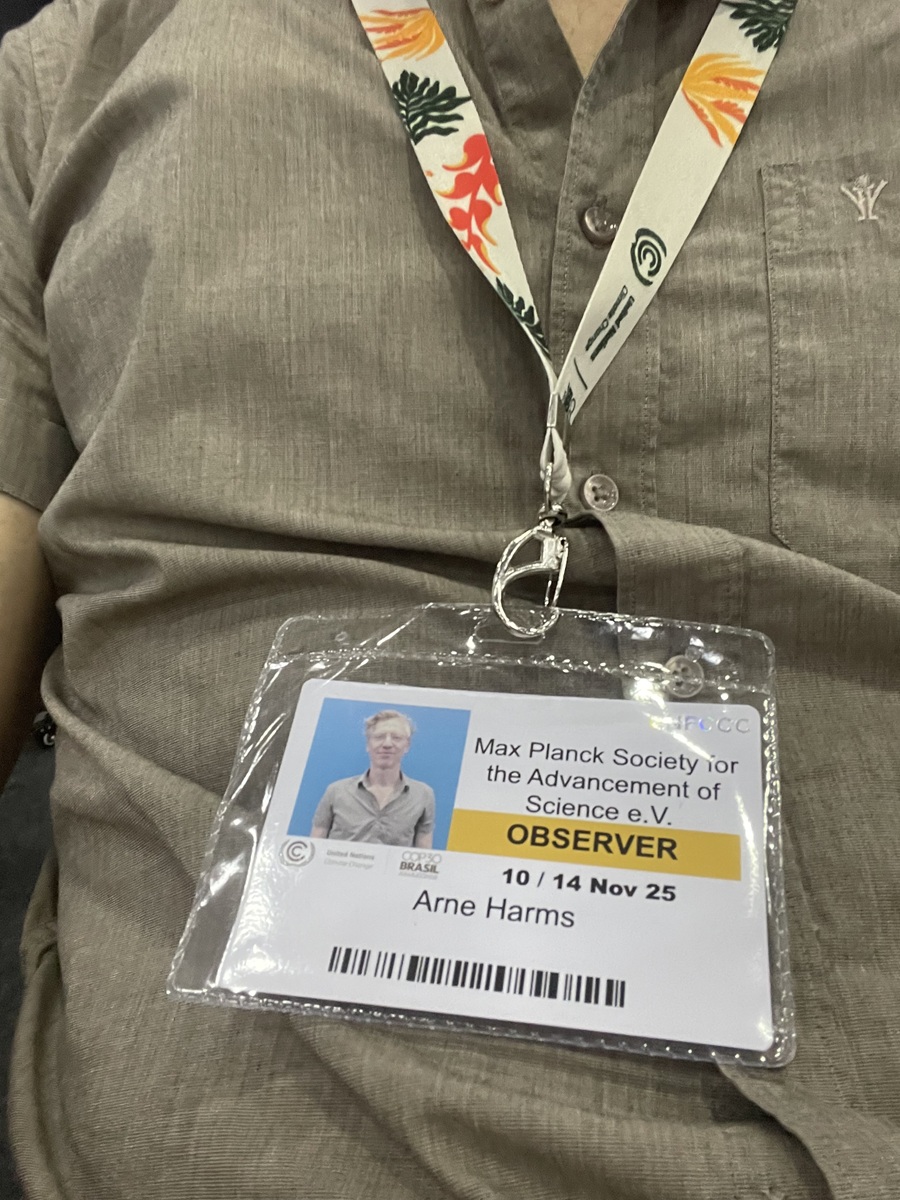
At one point, someone shouts at me “Hey, Max Planck! You can help us and join the line!” I register the voice, and know immediately that she addresses me. I carry my badge, identifying me visibly as an ‘observer’ sent by ‘Max Planck Society’ privileged with access to negotiations in week one. She must have grasped that I was torn between two roles (that of an observer and that of an activist), hovering around the activist line but watching the discussion between Indigenous activist and COP30 president unfold (rather than turning my back to these, and facing the crowd in a gesture of protection, as the other climate activists do). In forcing me to take a stand, the woman’s voice also highlights the mutual identification of people, affiliations and roles indicated in the tiny pieces of paper, plastic and fabric badges are; and, by extension, the politics of visibility in and around these spaces of global diplomacy.
During COP30, badges had a peculiar social life. They regulated access to the restricted zone of negotiations, the Blue Zone, and come to distributed through opaque channels of individual constituencies to which a certain number of badges had been allotted. As such, badges were subject of maneuvering, where badges were fought over or split among colleagues. Some appeared wearing their badges reluctantly, while others adorned them with glaring activist buttons (showcasing allegiances and enabling efficient organizing) or with buttons from earlier COP meetings (signaling veteran status). At the same time, badges were subject of envy for people wishing to enter the Blue Zone; and the ubiquity of badges in the streets of COP30’s Belem flooded by 50000 delegates certainly contributed to creating the festive and hopeful atmosphere enveloping the city throughout week one.
In the Blue Zone – governed by UN security protocol enforced by UN’s own security forces – badges serve as an extension of the passport. But rather than citizenship, badges testify professional affiliations and membership to delegations. COP30 badges qualified holders as ‘members of party’, ‘party overflow’, ‘observer’ or ‘journalist’, each granting different rights of access to negotiation rooms on the premises. Sometimes, the roles were not immediately clear: I have met employees of humanitarian organizations filling in as diplomats for poor countries; and many of the unusually high number of fossil fuel lobbyists present at COP30 will have similarly worn badges by country delegations.
Being Max Planck inside an activist blockade highlights a number of tensions stemming from doing activist research. Anthropologists have frequently explored the dilemmas of doing fieldwork among activists holding political visions close to their own. What is more important, they ask, producing evidence or joining the struggle? And how could one make up for either in cases where it’s simply not possible to do justice to both at one and the same time? Joining the line out there by the gate on that morning, I am debating internally whether this is just a tactical decision in fieldwork (getting me closer towards participant observation among climate activists) or whether I am simply living up to Charles Hale’s challenge when he says that cultural critique without joining the fight is just lazy (Hale 2006). But there’s more. It also signals the tensions emerging from being simultaneously a scholar, an activist and a delegate, and how much the role of a delegate shapes the possibilities of activist scholarship within this peculiar environment – this temporary mini-city catering to 50000 delegates convening to decide on humanity’s actions towards climate change.
A few days later, on a Sunday, which is an official day of rest of COP30 negotiations, I run into the woman again. We’ve both booked a trip with a responsible tourism collective, visiting women’s initiatives and herbal gardens on one of the many estuarine islands adjacent to Belem. On the boat, I learn that while we both qualified as observers, we were on fairly different trajectories and, therefore, subject to alternative politics of visibility. She had travelled to COP30 sent as delegate by a European Christian organization, aiming to witness and support efforts toward climate justice. In contrast, I had travelled to Belem as a delegate by a German Foundation pursuing fundamental research in the sciences and humanities. I was supposed to study, much less to witness or support.
Out there by the gate, a few days earlier, there hardly was time to reflect on matters of affiliation and strategizing. I remained absorbed by the dynamics of the protest as it unfolded around me. I was occupied with the appearance of suaveness by COP30’s president as he listened to activists, the bows and arrows piercing the air, the swaying of people moving in and out of the crowd, and the soldier’s disconcerting quiet as they overlooked the protest in riot gear, holding to their guns. The possibility of violence was palpable. After all, it seemed impossible to ascertain how security forces dealt with such kinds of direct action and whom they would count as perpetrator if things went south. At the very least, the protest’s transgressive and provocative nature had motivated many people in the crowd to tactically conceal parts of their identity. While many of the people around me carried their badges open, many others rather chose to conceal their badges. Quickly hidden under their shirts or blouses, affiliations were masked, while the characteristic, brightly printed lanyards on use during COP30 would still give away their being delegates.
Between being called upon as Max Planck and disappearing name tags, badges appear as critical elements within environmentalist action at COP30. On one level, they seem to join a number of visual cues allowing for an identification of persons (adding to printed shirts, Keffiyeh or feathered bands). On another level, they signal a tactical maneuvering with affiliations and the status of being a delegate. While some used buttons, printed shirts or flags carrying slogans as methods of broadcasting activist demands inside the premises, others chose to temporarily conceal their affiliations betting on the force of bodies on the streets precisely as an illegible mass to make demands. In showing or concealing their badges, people were not only engaged in keeping their names to themselves or not, they were also shifting gears in the politics of visibility. In this view, tactic positioning of badges complicates the means and ends of confrontational politics in or around the restricted spaces of diplomatic activity.
Arne Harms is an environmental anthropologist. Harms is a Senior Research Fellow working at Uni Münster and Max Planck Institute for Social Anthropology, in Halle (Saale), Germany. Read more about Arne’s work here: https://www.eth.mpg.de/harms
References
Hale, Charles R. 2006. “Activist Research v. Cultural Critique: Indigenous Land Rights and the Contradictions of Politically Engaged Anthropology.” Cultural Anthropology 21 (1): 96–120.